“The Marketplace of Ideas” by Louis Menand
 Parents, friends, university professors, family members, esteemed colleagues, and new acquaintances: we are gathered here today to answer a very important question. Why did a young man who has been passionate about the study of history his whole life, who has majored in history in college, excelled in its study, and wanted nothing more than to teach and learn about the past for the rest of his life, decide not to go to graduate school?
Let me leave that question hanging in the air of the (empty) auditorium, shrug off the narcissism (it was me speaking about myself, in case anyone had hoped otherwise), and step down from the podium.
The Marketplace of Ideas: Reform and Resistance in the American University by Louis Menand tries to answer the question of how American universities (more specifically, the liberal arts departments of those schools) have become the weird places that they are. For those who pursued a liberal arts education at a large university and don’t agree that they are strange beasts, I present the following observation of Prof. Menand’s:
It takes three years to become a lawyer. It takes four years to become a doctor. But it takes from six to nine years, and sometimes longer, to be eligible to teach poetry to college students for a living. (157)
Why? Menand, in his insightful book, answers the How? by tracing the history of the modern American university from its roots in the late-nineteenth century orientation toward research, through its gargantuan growth during the Cold War with the help of government funding, through the turbulent decades of the late-twentieth century and their epistemological crises (what are we doing this for? why are we here? and what right do we have?), to the current university that we see today.
But . . . Why? Why must a student devote nine years of his life to learn to think and talk in narrow ways, and then spend the rest of his life educating the public whose instincts (for better or worse, but usually for the better) cringe at the sound and sight of this narrowness? (more…)
“On the Road” by Jack Kerouac
 When I was younger, I used to love reading a good book so much that I never wanted it to end, never wanted to say goodbye to its characters. Now, in my relatively more mature years, I rarely get this feeling, though I still love to read good books. Reading the last page about Dean Moriarty, I felt little sadness.
Beat writer Jack Kerouac writes in the last pages of On the Road,
So Dean couldn’t ride uptown with us and the only thing I could do was sit in the back of the Cadillac and wave at him. The bookie at the wheel also wanted nothing to do with Dean. Dean, ragged in a motheaten overcoat he brought specially for the freezing temperatures of the East, walked off alone, and the last I saw of him he rounded the corner of Seventh Avenue, eyes on the street ahead, and bent to it again. Poor little Laura, my baby, to whom I’d told everything about Dean, began almost to cry.
“Oh, we shouldn’t let him go like this. What’ll we do?”
Old Dean’s gone, I thought, and out loud I said, “He’ll be all right.” And off we went to the sad and disinclined concert for which I had no stomach whatever and all the time I was thinking of Dean and how he got back on the train and rode over three thousand miles over that awful land and never knew why he had come anyway, except to see me.
Reading On the Road, I wondered whether the spirit of the character of Dean Moriarty had suffused itself into American culture – I saw it everywhere. The incessant traveler, lover of sights and people and smells, rubbing his belly for joy, sweating, American Odysseus without a home, Walt Whitman re-incarnate. Without Dean Moriarty, the journeys that author Jack Kerouac wrote about that he took with Dean would never have taken place. Dean was the leader. (more…)
The surrealism of war
 “Anything can happen in war”, writes Evgeni Bessonov in his memoir, Tank Rider: Into the Third Reich with the Red Army. This translation of a Russian soldier’s experiences fighting the Germans during World War II has been my recent reading staple. What does Bessonov mean when he writes that anything can happen in war?
What comes to mind for me when a veteran says something like that is something horrible about war: hand-to-hand combat, grenades blowing off limbs, losing friends in battle. But reading Bessonov’s memoir (and most other personal accounts of war) the reader encounters other stories which are equally surrealistic but not as gruesome.
Bessonov describes one instance when the Germans surprised his unit by attacking at night during a thunderstorm. His platoon retreated as they fought the enemy, but it was so dark that no soldier could tell whether the people around him were Russians or Germans. As rain poured over the forest, the darkness confused everyone and was only brilliantly interrupted by flashes of lightning, which clarified for the soldiers whether the man running next to him was a friend or an enemy. Both Russians and Germans ran through the woods in a kind of “cross country race” until they ran out of the forest and the Germans paused their assault (144-145).
In another encounter, Bessonov, who was a junior officer and only 21 years old at the time, describes getting an order from his superior officer to advance his platoon and attack the enemy. It was an altogether different day, sunny and warm, but Bessonov was exhausted from the night marches and daylight battles.
The sun started to warm us; it was quiet, one could hear only birds singing from the nearest forest, which was not yet occupied by our troops. I replied to the runner that I was about to start the attack; he left, and I again fell asleep. The runner from the company commander ran up again, with the same order and with threats from the company commander. I again replied that we would commence the attack any time soon and fell asleep again – such things had never happened to me before. The runner woke me up and again reminded me of the attack – this time, the company commander ordered him not to leave me before I started the attack. I slept under a bush on soft grass (I did not dig a trench), I had been dreaming about something peaceful and I really did not feel like dying in that quiet hour. . . I tried to think of death as little as possible, but at that moment I was merely overwhelmed by exhaustion and quietness and I really wanted to sleep. (139)
The poet Robert Frost famously likened death to sleep in his poem “Stopping by the Woods on a Snowy Evening“: “The woods are lovely, dark and deep / But I have promises to keep, / And miles to go before I sleep, / And miles to go before I sleep.” For Evgeni Bessonov in late August of 1944, the woods in front of his platoon where the enemy waited meant death. And sleep for him then was not an embrace of death, but the flight from it.
“The Few” by Alex Kershaw
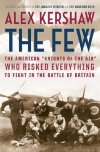 In my mind, the Battle of Britain is the most poignant icon of courage and heroism in history. It’s more epic than Lord of the Rings. It’s almost as if the events of the Battle of Britain came out of somebody’s imagination. I’m baffled that hardly any contemporary movies have been made depicting it.
Since the Norman conquest of 1066, England has never been invaded by a foreign army. This proud nation, which nurtured modern democracy for centuries as the aristocracy chipped away at monarchical power, which controlled the largest empire in human history, found itself, in the summer of 1940, on the verge of destruction at the hands of perhaps the cruelest power in history, Nazi Germany.
The only thing that stood in the path to Britain for the German army was a cadre of British airmen, teenagers and 20-year-olds, about 3,000 strong. Outnumbered and out-gunned, these young Englishmen and their allies beat back the German air force sent to pulverize Britain and prepare it for invasion. Like their ancestors 350 years ago who destroyed the Spanish Armada sent to conquer England, the pilots of the RAF Fighter Command during the Battle of Britain have carved their legacy into the minds of all who are attentive to the drama of history.
“The Few” by Alex Kershaw is an important book because it describes the American contribution to the Battle of Britain. America was officially neutral during the time of the Battle of Britain and trying desperately to stay out of the developing world war. Nevertheless, a few adventurous Americans broke neutrality laws, forfeited their American citizenship, and signed up to fly for the Royal Air Force in defense of Britain during the summer of 1940. There were only eight of them. Americans, who had revolted against King George III in the name of liberty, were now renouncing their American citizenship and swearing loyalty to King George VI, in the name of that same liberty.
The historical importance of the Battle of Britain was not lost on Winston Churchill. He captured the spirit of the glorious moment in his speeches during the summer of 1940. In June, in a speech before the House of Commons, he predicted the legacy the RAF pilots were about to write for themselves:
What General Weygand called the Battle of France is over. I expect that the Battle of Britain is about to begin . . . The whole fury and might of the enemy must very soon be turned on us. Hitler knows that he will have to break us in this island or lose the war. . . Let us therefore brace ourselves to our duties, and so bear ourselves that, if the British Empire and Commonwealth last for a thousand years, men will say, ‘This was their finest hour.’
“The Pacific” and “The Hurt Locker”
 I’m glad Avatar did not win the Academy Award for Best Picture this Sunday, and not just because it was over-hyped. The Hurt Locker was genuinely a much better film. I’ve seen many, many war films and The Hurt Locker was unlike any other. It portrayed a type of soldier that I did not know even existed, but, after seeing the movie, seems very real now. The Hurt Locker is about about a specialist in a U.S. Army Explosive Ordinance Disposal (EOD) team whose personal reasons for fighting in the Iraq War have nothing to do with patriotism, financial need, or even supporting his fellow soldiers. SFC William James is in Iraq because he is addicted to the adrenaline high of high-intensity combat.
The Hurt Locker opens with a quote by a New York Times war correspondent that summarizes the theme of the movie: “The rush of battle is a potent and often lethal addiction, for war is a drug.” For this unique portrayal of war, I think The Hurt Locker deserved all of the Oscars it received.
On another note, I am excited to watch the upcoming HBO miniseries The Pacific. Like the film Saving Private Ryan (1998) and the miniseries Band of Brothers (2001), this is another collaboration by Steven Spielberg and Tom Hanks portraying American soldiers during World War II, this time in the campaign against Japan. I am most curious about from what angle Spielberg and Hanks will approach this series to make it different from the others. Spielberg is such a great artist and storyteller, in my opinion, that this won’t just be “another war film”.
Saving Private Ryan is a monumental film – it’s an icon of the horrific events of D-Day, June 6, 1944, in the imagination of a younger generation of Americans. Band of Brothers is also unique in that it follows a single unit of American paratroopers throughout their combat experiences during the entire war, but in a style similar to another HBO series, The Sopranos, where each episode focuses on a different character to create a portrait of the entire group. What will The Pacific be like? I’m eager to find out (the first episode premieres on Sunday, March 14 at 8p CST on HBO).
On a final note, Christoph Waltz, who won the Oscar for Best Actor in a Supporting Role this year for portraying a Nazi “Jew Hunter” in Inglorious Basterds, performed one of the best feats of acting I have ever seen. If you haven’t seen this movie, go see it if for nothing other than to watch Christoph Waltz portray Standartenführer Hans Landa, whom director Quentin Tarantino described as “one of the best characters I’ve ever written and ever will write”.
On effective introductions
 Earlier today, I was in a Barnes & Noble store looking for an interesting book. On trips like these, I usually open dozens of books to read or skim the first paragraph, only to shelve them because the way the writer introduces the story doesn’t seize my long-term attention (visitors to my blog may experience a similar feeling reading these posts). I was surprised today when I found an intriguing book less than a minute after entering the store (in the bargain crates before the main entrance, in fact). It was Alex Kershaw’s The Few: The American “Knights of the Air” Who Risked Everything to Fight in the Battle of Britain.
I have browsed this book on previous visits to B&N, only to put it back on the shelf like many others. This (and other similar experiences) suggests to me that why a book catches a viewer’s attention has a lot to do with when it catches his attention: we see the world through different eyes depending on what state of mind we are in. Today, I was drawn to Kershaw’s story by the beautiful poem, written by a young American fighter pilot, Kershaw had reproduced as an introduction to his book (which reminded me of a famous poem by W.B. Yeats). Here is a copy it:
High Flight
Oh! I have slipped the surly bonds of earth
And danced the skies on laughter-silvered wings;
Sunward I’ve climbed, and joined the tumbling mirth
Of sun-split clouds—and done a hundred things
You have not dreamed of—wheeled and soared and swung
High in the sunlit silence. Hov’ring there,
I’ve chased the shouting wind along, and flung
My eager craft through footless halls of air.
Up, up the long, delirious, burning blue
I’ve topped the wind-swept heights with easy grace
Where never lark, or even eagle flew—
And, while with silent lifting mind I’ve trod
The high untrespassed sanctity of space,
Put out my hand and touched the face of God.—John Gillespie Magee, Jr.
Nineteen-year-old American pilot, killed December 11, 1941
History, the History Channel, and Dairy Queen
 You feel a bit silly when you find yourself – an adult man – sitting alone in an otherwise-empty Dairy Queen store, licking a soft-serve ice cream cone. This was the situation in which I found myself yesterday after I deposited a check at my bank and, pulling out of the parking lot, decided to park again and buy some ice cream. I usually don’t have cravings for ice cream during late winter, but this time I couldn’t resist.
I’ve been visiting this shopping plaza biweekly for the past four months, and yesterday (Friday) was the first time I’ve noticed that there was a Dairy Queen store next door to my bank. I usually ignore Dairy Queens for the same reason I ignore Baskin-Robbins and Dunkin’ Donuts: I hate their pink signs and bubbly graphic art trying to convince me everybody’s having a good time inside the store when it’s actually usually empty. It’s inauthentic and corporate and depressing.
Those were my thoughts about Dairy Queen until this Thursday, when I had come home from work and, in lieu of going to the gym, had decided to watch an episode of Modern Marvels about ice cream on the History Channel. I used to think Modern Marvels – a documentary series about modern technology – was an impostor on the History Channel, taking up valuable air time that could be better utilized by a show about the history of the samurai, the story of the Romanov dynasty, or even yet another special about World War II. But I’ve recently come to respect Modern Marvels for doing what good history does as well: make the present artificial world (what humans create apart from the natural world) more understandable.
In his classic book of popular philosophy, Zen and the Art of Motorcycle Maintenance, Robert Pirsig claims that the reason many people in the modern world feel alienated by the sight of technology (imagine the feeling you get driving past an electric power station) is because they don’t understand the “mind” behind the metallic beast. That is, if they only understood how technology worked, people would feel a lot less threatened by it. In fact, they would perhaps even begin to think of the electric power station as almost beautiful.
The Modern Marvels episode I watched on Thursday described the technology of making ice cream, as well as the history of the famous franchise Dairy Queen, the originators of soft-serve ice cream. I was surprised to see a photo of the grand opening of the first Dairy Queen in 1940 in Joliet, Illinois: throngs of families crowding the store on a hot summer day. The franchise spread, and Dairy Queens became almost emblematic of small-town American life in the 1950s and 1960s.
After watching about the technology and history of ice cream in America on Thursday, I felt it fitting and proper on Friday, when I noticed for the first time the Dairy Queen (now known as “DQ”) next to my bank , that I would stop by and take part in an American ritual. The store was empty, as I expected. A women’s college basketball game was playing on a flat-screen TV in the back of the store. The graphic design in the store looked like it was imported from a design agency in New York or California which no doubt held many meetings to come up with a way to convey the message, through bright signs printed on cheap and durable materials, of “zany”.
I ordered a cone with a stack of puffy soft-serve ice-cream layers that I remembered seeing on Modern Marvels. I sat at a booth and enjoyed my dessert while looking at the framed photographs hung on the wall: black-and-white, showing Dairy Queen shops of the past, the only monochrome design elements in the store. I thought to myself that I looked out of place here because a grown man should not be eating ice cream alone, especially in the evening during winter.
Before I finished my cone, a man had walked into the store, the only other customer aside from me. He had graying hair and was dressed in neat business-casual attire. He too ordered soft serve and sat at a booth by the main door. Another grown man buying an ice-cream cone by himself – perhaps I wasn’t so crazy after all. On my way out of the DQ, I passed by the man: he was eating his ice cream and typing on a Blackberry.
Walking by his Lexus SUV in the parking lot, I imagined that the man in the DQ had grown up in the 1960s in one of those small towns I had heard about on the History Channel. He would go to the Dairy Queen with his parents and siblings, and there would be neighbors and friends that he expected to see there. I imagined that now, in his 50s, that man sometimes drives by a DQ and childhood memories prompt him to stop, come inside, and partake of a dead ritual. I thought about this while I drove home.
My recent work as a web designer has made me more sensitive to art and design in my environment. I can walk into a zany Baskin-Robbins/Dunkin’ Donuts combo store without feeling sick with myself as I used to feel, because now I understand the design process that went into creating the persuasive graphical monstrosity that permeates such corporate places. But understanding something foreign and powerful doesn’t necessarily mean you want to be on board. Sometimes the bright-and-colorful relics of the present are more dead than the black-and-white memories of the past.
Shelved: “Crowded with Genius” by James Buchan
 In the past, I’ve done several reviews on this blog of books that I had just finished reading. But it often happens that I start a book without finishing it or shelve it for a while only to come back to it later (when I read The Brothers Karamazov, I repeated this process several times over the course of a year until I finally finished it). Well, I thought such “shelved books” deserve a review sometimes as well.
I have developed a habit recently where I go to the library or a bookstore and rove around the aisles browsing books at random for hours on end. This is more disturbing for me to do at a bookstore than at a library, because I am afraid that the managers will suspect me of being a shoplifter or loafer. Despite this, it amuses me to observe what books I naturally gravitate towards while giving my imagination free reign. I was at my local library in such a mood a couple of weeks ago when I picked up Crowded with Genius: The Scottish Enlightenment – Edinburgh’s Moment of the Mind by James Buchan.
This book interested me because I had heard about it while doing research for my senior thesis. Like Athens in the 400-300s B.C., Edinburgh became an unlikely center of culture and learning during the 18th century, hosting such great thinkers as David Hume and Adam Smith. Buchan writes:
The town, which had sat little changed on its rock until then, inconvenient, dirty, old-fashioned, alcoholic, quarrelsome and poor, began to alter, first slowly, then in a convulsion. Lochs were drained, ravines spanned by bridges, streets and squares thrown out into the stony fields. Ale gave way to tea and port and whisky. People dined at one o’clock, then two, then three, and then four.
Men discovered there were ways of charming women this side of abduction. They ceased to bring their pistols to table, or to share the same cup. They read newspapers, became Freemasons, danced, burst into tears. [. . .] A new theory of progress, based on good laws, international commerce and the companionship of men and women, displaced the antique world of valour, loyalty, religion, and the dagger. ‘Edinburgh, the Sink of Abomination’ became ‘Edinburgh, the Athens of Great Britain’. (1-2)
The narrative begins strongly but later gets bogged down in the details of old Scottish politics (this book was first released in Scotland). If I were more patient, I would do the page-flipping and wikipedia-searching necessary to untangle the web of ideologies and political alliances that the book describes. But, I was drawn to this book at the library out of all of the others because of the adventurous storytelling, and when that waned, the book was shelved (it was also overdue). To a more patient mind, it holds a lot of promise (even past page 98, where I stopped). At the very least, it’s worth coming back to.
Many history blogs
 When I started historyjournal.org, I thought there were relatively few people blogging about history. I’ve since learned that there are many such blogs on all kinds of topics. Below are two helpful lists of quality history blogs:
1. Cliopatria’s History Blogroll (Part 1 | Part 2)
2. Top 50 Biblical History Blogs
My current blogroll consists of PaleoJudaica.com (biblical history), Easily Distracted (history and academia), Cliopatria (general history), AHA Blog, and Pedablogue (an awesome blog about pedagogy).
“Dead Sea Scrolls and the Bible” exhibit in Milwaukee
 Milwaukee’s Journal Sentinel has reviewed a new exhibit at the Milwaukee Public Museum called “Dead Sea Scrolls and the Bible”. The reviewer applauds the installation, which features objects from Qumran but also many general artifacts from biblical times.
Looking through the photo slide-show attached to the review, I perceive that the exhibit is laid out according to a new style of exhibit display. When I visited the new Abraham Lincoln Presidential Library and Museum in Springfield, IL a few years ago, I noticed that the museum had chosen a fresh approach to museum design. Instead of overwhelming the viewer with a plethora of artifacts and informational plaques, the museum recreated historical environments in each of its varying rooms. One room was Lincoln’s childhood cabin. Another was his funeral visitation room. Each display was artfully lit, engaging, and informative without being overwhelming.
From what I can tell, this style has caught on and the “Dead Sea Scrolls and the Bible” exhibit appears to be equally refreshing. Perhaps it’s time for me to visit Wisconsin again.
 HistoryJournal.org
2 comments