“Go, present yourself to Ahab”
 Herman Melville’s Moby Dick is one of those classic novels which I’ve picked up to read several times in former years — only to put it back on the shelf. My enthusiasm has died several deaths on the rack of 19th-century prose. But when I started reading it again last week, I was finally hooked.
What I didn’t realize before was that Moby Dick is a retelling (or at least it seems this way to me through page 80) of the biblical book of Jonah. That book is one of the pithiest in the Bible. In the span of four chapters, Jonah tries to escape from an errand God has earmarked for him but is finally persuaded to return and complete it after spending three days repenting in the stomach of a whale.
Melville spells out the analogy to the Jonah story by having his narrator — Ishmael — listen to a sermon about the book of Jonah early in Moby Dick. The sermon is delivered by an old sea captain turned pastor in a church which resembles as much the inside of a whaling ship as it does a place of worship. But this captain-pastor adds many details out of his imagination to the story of Jonah. Much like Melville in the entirety of Moby Dick.
Ishmael represents Jonah, escaping from unpleasant realities on land by running away to sea. If Ishmael is Jonah, his cannibal friend Queequeg may represent the Gentile shipmates with whom Jonah sailed. Captain Ahab may represent the wicked Ninevites in the book of Jonah. But Ahab is also an idolatrous Israeli king talked about in several other books of the Hebrew Bible. Captain Ahab’s obsession with the white whale seems to be like the idol-worship that is condemned in many books of the Hebrew Bible.
I’m just a fraction of the way into the book, but I like how Melville has taken a well-worn short story from the Bible and created an elaborate modern version out of it. Moby Dick, published in 1851, may seem like a far-removed story to 21st-century American readers, but if you keep in mind that it’s retelling a story that’s actually over 2,000 years old, Herman Melville’s novel comes off as remarkably contemporary.
Memoirs of a Russian submariner
 In high school English class, I was taught about the three general types of conflict that one may encounter in literature: Man vs. Nature, Man vs. Man, and Man vs. Self. Memoirs from combatants of the Second World War are often as exciting to read as literature because all three types of conflict figure into them on a grand scale. But there is a fourth type of conflict that we didn’t learn about in class but which, particularly for the men and women of the Soviet armed forces, added that extra dimension of drama: Man vs. Machine.
The nation that brought the world Lada and Zhiguli cars–which asked of their owners to spend nearly every weekend under their jacked-up chassis salving their ever-irritated metal bowels–produced submarines during WWII that would never quite pass muster in an American or German shipyard. This run-down state of submersible machinery can be fully appreciated by reading Victor Korzh’s memoir, Red Star Under the Baltic: A Soviet Submariner in WWII.
As the chief engineer aboard these subs, Korzh knew every nut and bolt and describes their mechanical failures with the technical detail befitting a master. But the inability of Soviet designers and shipyards to perfect submarine design is no stain on the reputation of the Russian sailor. On the contrary, the Russian submariners’ ability to not only survive but also sink many German merchantmen in the unforgiving seas of the Baltic is a testament to their boldness and technical ingenuity. (more…)
History off the press (August ’11 edition)

Have your relatives ever told you stories about your ancestors that made you reevaluate your own identity? My grandmother once told me that her father (my great-grandfather) possessed a mellifluous voice and staged concerts for his fellow Allied soldiers imprisoned in a German POW camp during World War I. Hearing this story, it made me question how genetic quality could dissipate so quickly, for my vocal chords can’t produce a single melodic note if my family’s honor depended on it.
Like talking to our grandparents about departed relatives, reading history can change our perspective about our own selves or our community. I selected the books for August (remember, these are previews, not reviews: I have not read these books yet) that drew me in either because they addressed a need for self-knowledge or promised to inform me about the world around me. As a result, almost of them, I noticed later, have to do with U.S. history. But I think our subjectivity is what lights our interest afire. Our bias is our personality, and without it history narratives wither before us like dehydrated fruit.
New York City roots
For several months, I’ve had an itch to discover “literary” neighborhoods in Chicago. Seeking counsel, I asked fellow Chicagoans (full disclosure: I live in the suburbs, not the city proper) where writers live or congregate in the Windy City. No one had an answer, which made me despair that the only destination for writers in the United States was prohibitively-expensive Manhattan. (more…)
Symbolic reactions
 In the deserts of the Middle East, goatskin seems to have been the material of choice for transporting water. This seemed strange to me when I first read about it in Wilfred Thesiger’s account of his travels in the sands of the Arabian Peninsula with the Bedouins. The way he described it, it seemed these goatskins had a tendency to sweat in the blistering sun and tear and leak their irreplaceable cargo as the nomads traveled from well to well.
Thesiger’s narrative formed images in my mind: the goatskin containers bulging with water and bouncing on a camel’s back; moisture congealing on the skins and falling in small droplets to sizzle on the sand; the Bedouins (and Thesiger with them) drinking gladly the animal-scented liquid at the end of a long day’s ride. Soon these water-bearing goatskins became for me part of a larger symbolism that I had affixed to the Bedouin lifestyle.
The nomadic Arabs were a complex people in Thesiger’s account. Ready to drive a knife through the chest of a child from a competing tribe if the customs of a blood-feud demanded it, the same Bedouin man would literally give the last shirt off his back or the last swigs of camel’s milk to a stranger who happened upon his camp. To me, reading and re-reading Thesiger’s book, Bedouins came to represent a love of freedom, a fraternal devotion to clan, and a proud contentedness with simple living.
But I have never met any real Bedouins (I’m not counting the hospitable entertainers of Bedouin descent who served coffee and rice for our Birthright Israel group before returning to their mansion in the desert for the night). Bedouins, along with their goatskin water bottles that I have never actually seen, exist only in my mind as symbol and metaphor. (more…)
World War I and the unconscious
 I was in Barnes & Noble earlier today and, intrigued by the cover of the latest Time magazine (which oddly featured a full-page photograph of Abraham Lincoln), I realized that the 150th anniversary of the beginning of the Civil War is coming up in three days (April 12, 2011). Such numerically-significant anniversaries are rare occasions for the national discourse to turn and (briefly) examine the significance of history to contemporary life. I always seem to miss these kinds of precious discussions. Currently, I’m working through Paul Fussell’s The Great War and Modern Memory and am still on the early-20th-century wavelength (oh! where was the 150th anniversary of the firing on Ft. Sumter when I was reading Paul Menand’s The Metaphysical Club and was on my Civil War “kick”?).
Fussell’s book, though, is yielding too much nutritious food for thought to put aside. In the chapter titled “Adversary Proceedings”, Fussell quotes 20th-century psychologist Carl Jung for whom the First World War was such a such a strong influence that it crept into his dreams after (and, if we are to believe his enigmatic Red Book, even before) the war:
[Jung] dreamed that he was ‘driving back from the front line with a little man, a peasant, in his horse-drawn wagon. All around us were shells exploding, and I knew that we had to push on as quickly as possible, for it was very dangerous [. . .] The shells falling from the sky were, interpreted psychologically, missiles coming from the “other side.” They were, therefore, effects emanating from the unconscious, from the shadow side of the mind [. . .] The happenings in the dream suggested that the war, which in the outer world had taken place some years before, was not yet over, but was continuing to be fought within the psyche.’
Reading this quote by Jung made me think of something that has fascinated me about psychology for some years. Specifically, it’s been a mystery to me how widely the ideas of Sigmund Freud, the founder of psychoanalysis and an iconic figure, were taken up by the Western world and how deeply ingrained some of them have become even though many of his theories were not very scientific. (more…)
The death of “high” diction
 Like anyone who reads a lot of books written before one’s grandparents were born, the imaginary world of literature and history begins in the mind to contend with the perception of the immediate world of real life. Outmoded words begin to enter the vocabulary, and must be consciously prevented from escaping into the daylight of ordinary conversation. One instinctively knows that words like “valor”, “comradeship”, and “foe” have no place in everyday language (“How was your basketball game today?” “Oh, it was a great! My comrades and I vanquished the foe 3-1.”) though words such as these crop up in older writings all of the time. Like chivalry, these “high” forms of speaking are now dead. But what killed them?
This week, I started reading The Great War and Modern Memory (1975) by Paul Fussell, which describes the traumatizing shock that the First World War delivered to the Western psyche. To die with the millions of soldiers in combat was a European idea about the perfectibility of mankind and society. The effect of this collective experience lasts to this day, even in America.
The summer before the war, the summer of 1914, was memorable for its picnic-perfect weather. During these warm summer months, Europe (especially Britain, which hadn’t really seen war for a hundred years) breathed the air of chivalry, romanticism, and boundless self-confidence for the last time. The shock of the war to come contrasted so sharply with the idyllic season before it (Fussell describes at length in the first chapter how this dichotomy created a sharp and enduring impression of the irony of life on the Western psyche), that “the summer of 1914” would for many decades become synonymous with astonishing naiveness.
To illustrate how this change took place, Fussell relates a handful of the countless ironic (meaning, having one’s optimistic hopes about the future punished with exaggerated misery instead) experiences that soldiers witnessed during the war. Fussell quotes one instance from another author’s memoir: (more…)
Goal-oriented
 I used to get a lot more excited about goals that I set for myself than I do now. Now, I’ve grown to mistrust any kind of concrete goal to such an extent that, believe it or not, I still haven’t written down my New Years Resolutions for 2011 even though I fully intend to at some point (I like to tell myself).
This week, I’ve been reading Dave Goetz’s Death by Suburb, a study of how to improve a suburbanite’s “spirituality”. In his chapter titled “Inside Space”, Goetz discusses this idea of goal futility.
Not to echo here the disillusionment of Ecclesiastes (you know, “Vanity of vanities! All is vanity”) but it seems impossibly hard to correlate happiness with goal achievement. The suburbs are a great illustration of this idea.
The suburban environment is one where individuals are cloistered into safe and sanitary housing units where each person creates goals, capitalizes on the abundant opportunities available, and then amasses the spoils of his labor in the form of goods or social status. It’s almost the epitome of “the good life”. And yet almost anyone who actually experiences this kind of lifestyle will feel some sort of dissatisfaction with goal achievement.
The new car just doesn’t seem so satisfying a few months after the purchase (but how much work went into affording it). The mansion seems a lot better as an idea than as a reality. Yes, the friends will be impressed, but why do I need to lord it (or anything) over them? And what do I admire about the thing itself – the spaciousness, the beauty of the woodwork and wall colors and flooring? The outdoors are spacious too and there are much more beautiful buildings to be seen in the city. I must just want to possess this immensity and this beauty as my own.
And yet these goals require so much – perhaps, all – of our work capacity to fulfill. For someone like me who always needs a plan to feel at ease with himself, it’s maddening that the things that really matter to us – love, vocation, relationships – we can’t really achieve by setting any kind of goals. Goetz thinks that relinquishing control and embracing silence can help a suburbanite find the peace of mind of which the achievement race robs us. I don’t know about this; I just think it’s maddening that we can’t goal-orient towards happiness.
Subtle intrusions of comfort
 I have recently been reading Pete Blaber’s memoir, The Mission, The Men, and Me: Lessons from a Former Delta Force Commander, about his experiences during training and in combat around the world (including action in Iraq and Afghanistan). As may be gleamed from some of my previous posts, I have a high degree of admiration for battle-tested warriors such as this Chicago-born operative in the military’s perhaps most unconventional unit.
During late 2001 and early 2002, when Americans special forces were making their first incursions into Afghanistan, Pete Blaber was commanding a detachment of advanced force operations (AFO) soldiers. He describes this early phase of the war in Afghanistan as an uncharacteristic one.
The U.S. government, according to Blaber, knew very little about the country they were invading, and special forces were sent in to acquire contextual information and carry out the initial attacks on the enemy. Since the character of the war to come was still unknown, these various units were allowed to organize and operate in a way that did not necessarily reflect their usual departmental divisions. Combat teams were frequently formed and reformed around a mix of AFO, the Green Berets, and CIA agents as need dictated without a regard for traditional military structure. In true special forces fashion, the only thing that mattered was completing the mission no matter how unconventional the means.
Much like I am in awe of master craftsmen who restore old aircraft, I am stunned by the audacity of the challenges that such special forces troops undertake. My confusion about the morality of war aside, when viewed simply as a problem-solving endeavor, the task of entering a hostile country in small teams of a few dozen men to chase out the entire ruling class baffles the mind. Sure the U.S. soldiers were equipped with the latest supplies and technology to help them accomplish this mission (not to mention scores of Northern Alliance soldiers as allies), but as Blaber describes and the U.S. military had to learn the hard way, technology is never a substitute for one of the basic assets of warfare: contextual knowledge of the people, locations, customs, and ways of thinking of others, especially the enemy. (more…)
Things, categories, patterns
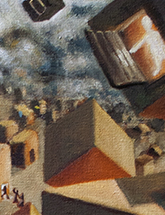 I don’t remember the topic of the discussion. I don’t recall who attended class that day. I cannot see in my mind’s eye now where I was sitting in that cavernous room in the basement of the bare-concrete humanities building. I just remember the voice of my history professor saying, in passing, to everyone in the senior thesis seminar that at some point in his twenties he had been “scrutinizing his categories”.
These strange words have stuck with me ever since, and I do remember pausing in class that day and mulling over them in my mind. What he meant, I think, was that at some point during his young adulthood he had thought about how he had come to know what he knows. For some foolish reason, these words of his began to emit in my mind the heady aroma of prophecy, and soon enough my memory of them had come to mean, “I too will scrutinize my categories one day in the near future, will rethink how it is that I have come to ‘know’ what I ‘know'”.
Truth is, though, I like talking about epistemology (the branch of philosophy that deals with the nature of knowledge) about as much as I like seeing zoomed-in photographs of my face. Beliefs, like human skin, begin to reveal bizarre characteristics when seen up close. The problem is not so much with the beliefs or thoughts themselves as with our ability to scrutinize them. Most people, myself included, are just bad at coming up with insights about the way we think. Here is how a typical conversation about epistemology sometimes goes:
Svetlana: How do we know what we know?
Larry: Well, the world exists as an external entity. The individual person exists as a separate entity that sees, hears, smells, feels and tastes things in the world with his senses and understands the world through his mind.
So we understand an external world through our senses and with our mind?
Yes.
And our understanding of our world is always accurate? (more…)
On tricking ourselves
 Even though I still read them once in a while, I am generally skeptical of self-help books. They are always incomplete, in my opinion, because they have to boil down scientific research (if they are even based on science) into easy-to-sell concepts and action steps. Getting Things Done is a good example. A recent classic in the “productivity” branch of self-help literature, GTD’s entire system is based on a ridiculous notion: to truly feel relaxed in the world, one must have all of one’s actionable ideas “captured” into sorted lists. Can you really enjoy a casual walk with a friend, the argument goes, while not having a written account of all of your preferences and next-actions for all of your projects close at hand?
The answer is yes, in my opinion, yes you can enjoy your life without planning it every step of the way. The assumption the book makes becomes a personal-productivity tyrant: one can scarcely have an idea pass through one’s head without feeling an obsessive urge to write it down in one list or another.
Of course by “one”, I am referring to myself. That is not to say that I will credit the plethora of useful lists I keep for work-related tasks and the tickler file I employ in my office to none other than David Allen, the writer of Getting Things Done. I just realize that any self-help book is going to offer partial solutions to any problem, and one must have a healthy capacity for what Aristotle called “practical wisdom”, phronesis, to pick and choose what’s useful for one’s life.
So when I perused the Chicago Tribune’s weekly literary section – Printers Row – one day in early January, I read the article titled “Seven books to aid in your new year’s resolutions” with a large grain of salt. But one book did catch my eye, and with the glad-handed aid of Amazon’s cursed 1-click purchasing system, I ordered and downloaded Switch: How to Change Things When Change is Hard onto my e-reader device. (more…)
 HistoryJournal.org
2 comments