The perils of manipulation
 A Mosque in Munich: Nazis, the CIA, and the Rise of the Muslim Brotherhood in the West
by Ian Johnson.
Houghton Mifflin Harcourt, 318 pp., $27 (or free at your local library).

Most people in the United States know that the CIA supported and equipped the mujahideen to fight against the Soviets in Afghanistan during the 1980s. This, and the dangers of such a strategy, are now common knowledge. What most Americans don’t know and what journalist Ian Johnson has investigated and described in his book, A Mosque in Munich, for the first time, is that the US strategy of using Islam as a tool of foreign policy has an even longer history that stretches back to events surrounding the Second World War.
This story is one of harsh realpolitik with many covert operations conducted by the US, West Germany, and the Muslim Brotherhood that centered around a mosque in Munich during the Cold War. There are few relatable characters in Johnson’s book, but several of them led colorful lives of travel and geopolitical intrigue as they struggled to co-opt the religion of Islam for national or ideological purposes.
Kaiser Wilhelm II was perhaps the first modern European leader to engage in this kind of manipulation with the goal of undermining another Western power, England, in the diplomatic wrangling leading up to World War I (a book devoted to this topic, The Berlin-Baghdad Express: The Ottoman Empire and Germany’s Bid for World Power by Sean McMeekin, was published in September).
The Germans picked up on this idea during World War II, when they realized that many Muslims living in the Soviet Union were embittered citizens and could be convinced to fight in Nazi uniform against the Soviets when they were captured. About 150,000 Soviet Muslim prisoners volunteered for service in the German army during World War II.
“The Marketplace of Ideas” by Louis Menand
 Parents, friends, university professors, family members, esteemed colleagues, and new acquaintances: we are gathered here today to answer a very important question. Why did a young man who has been passionate about the study of history his whole life, who has majored in history in college, excelled in its study, and wanted nothing more than to teach and learn about the past for the rest of his life, decide not to go to graduate school?
Let me leave that question hanging in the air of the (empty) auditorium, shrug off the narcissism (it was me speaking about myself, in case anyone had hoped otherwise), and step down from the podium.
The Marketplace of Ideas: Reform and Resistance in the American University by Louis Menand tries to answer the question of how American universities (more specifically, the liberal arts departments of those schools) have become the weird places that they are. For those who pursued a liberal arts education at a large university and don’t agree that they are strange beasts, I present the following observation of Prof. Menand’s:
It takes three years to become a lawyer. It takes four years to become a doctor. But it takes from six to nine years, and sometimes longer, to be eligible to teach poetry to college students for a living. (157)
Why? Menand, in his insightful book, answers the How? by tracing the history of the modern American university from its roots in the late-nineteenth century orientation toward research, through its gargantuan growth during the Cold War with the help of government funding, through the turbulent decades of the late-twentieth century and their epistemological crises (what are we doing this for? why are we here? and what right do we have?), to the current university that we see today.
But . . . Why? Why must a student devote nine years of his life to learn to think and talk in narrow ways, and then spend the rest of his life educating the public whose instincts (for better or worse, but usually for the better) cringe at the sound and sight of this narrowness? (more…)
“On the Road” by Jack Kerouac
 When I was younger, I used to love reading a good book so much that I never wanted it to end, never wanted to say goodbye to its characters. Now, in my relatively more mature years, I rarely get this feeling, though I still love to read good books. Reading the last page about Dean Moriarty, I felt little sadness.
Beat writer Jack Kerouac writes in the last pages of On the Road,
So Dean couldn’t ride uptown with us and the only thing I could do was sit in the back of the Cadillac and wave at him. The bookie at the wheel also wanted nothing to do with Dean. Dean, ragged in a motheaten overcoat he brought specially for the freezing temperatures of the East, walked off alone, and the last I saw of him he rounded the corner of Seventh Avenue, eyes on the street ahead, and bent to it again. Poor little Laura, my baby, to whom I’d told everything about Dean, began almost to cry.
“Oh, we shouldn’t let him go like this. What’ll we do?”
Old Dean’s gone, I thought, and out loud I said, “He’ll be all right.” And off we went to the sad and disinclined concert for which I had no stomach whatever and all the time I was thinking of Dean and how he got back on the train and rode over three thousand miles over that awful land and never knew why he had come anyway, except to see me.
Reading On the Road, I wondered whether the spirit of the character of Dean Moriarty had suffused itself into American culture – I saw it everywhere. The incessant traveler, lover of sights and people and smells, rubbing his belly for joy, sweating, American Odysseus without a home, Walt Whitman re-incarnate. Without Dean Moriarty, the journeys that author Jack Kerouac wrote about that he took with Dean would never have taken place. Dean was the leader. (more…)
The surrealism of war
 “Anything can happen in war”, writes Evgeni Bessonov in his memoir, Tank Rider: Into the Third Reich with the Red Army. This translation of a Russian soldier’s experiences fighting the Germans during World War II has been my recent reading staple. What does Bessonov mean when he writes that anything can happen in war?
What comes to mind for me when a veteran says something like that is something horrible about war: hand-to-hand combat, grenades blowing off limbs, losing friends in battle. But reading Bessonov’s memoir (and most other personal accounts of war) the reader encounters other stories which are equally surrealistic but not as gruesome.
Bessonov describes one instance when the Germans surprised his unit by attacking at night during a thunderstorm. His platoon retreated as they fought the enemy, but it was so dark that no soldier could tell whether the people around him were Russians or Germans. As rain poured over the forest, the darkness confused everyone and was only brilliantly interrupted by flashes of lightning, which clarified for the soldiers whether the man running next to him was a friend or an enemy. Both Russians and Germans ran through the woods in a kind of “cross country race” until they ran out of the forest and the Germans paused their assault (144-145).
In another encounter, Bessonov, who was a junior officer and only 21 years old at the time, describes getting an order from his superior officer to advance his platoon and attack the enemy. It was an altogether different day, sunny and warm, but Bessonov was exhausted from the night marches and daylight battles.
The sun started to warm us; it was quiet, one could hear only birds singing from the nearest forest, which was not yet occupied by our troops. I replied to the runner that I was about to start the attack; he left, and I again fell asleep. The runner from the company commander ran up again, with the same order and with threats from the company commander. I again replied that we would commence the attack any time soon and fell asleep again – such things had never happened to me before. The runner woke me up and again reminded me of the attack – this time, the company commander ordered him not to leave me before I started the attack. I slept under a bush on soft grass (I did not dig a trench), I had been dreaming about something peaceful and I really did not feel like dying in that quiet hour. . . I tried to think of death as little as possible, but at that moment I was merely overwhelmed by exhaustion and quietness and I really wanted to sleep. (139)
The poet Robert Frost famously likened death to sleep in his poem “Stopping by the Woods on a Snowy Evening“: “The woods are lovely, dark and deep / But I have promises to keep, / And miles to go before I sleep, / And miles to go before I sleep.” For Evgeni Bessonov in late August of 1944, the woods in front of his platoon where the enemy waited meant death. And sleep for him then was not an embrace of death, but the flight from it.
Shelved: “Crowded with Genius” by James Buchan
 In the past, I’ve done several reviews on this blog of books that I had just finished reading. But it often happens that I start a book without finishing it or shelve it for a while only to come back to it later (when I read The Brothers Karamazov, I repeated this process several times over the course of a year until I finally finished it). Well, I thought such “shelved books” deserve a review sometimes as well.
I have developed a habit recently where I go to the library or a bookstore and rove around the aisles browsing books at random for hours on end. This is more disturbing for me to do at a bookstore than at a library, because I am afraid that the managers will suspect me of being a shoplifter or loafer. Despite this, it amuses me to observe what books I naturally gravitate towards while giving my imagination free reign. I was at my local library in such a mood a couple of weeks ago when I picked up Crowded with Genius: The Scottish Enlightenment – Edinburgh’s Moment of the Mind by James Buchan.
This book interested me because I had heard about it while doing research for my senior thesis. Like Athens in the 400-300s B.C., Edinburgh became an unlikely center of culture and learning during the 18th century, hosting such great thinkers as David Hume and Adam Smith. Buchan writes:
The town, which had sat little changed on its rock until then, inconvenient, dirty, old-fashioned, alcoholic, quarrelsome and poor, began to alter, first slowly, then in a convulsion. Lochs were drained, ravines spanned by bridges, streets and squares thrown out into the stony fields. Ale gave way to tea and port and whisky. People dined at one o’clock, then two, then three, and then four.
Men discovered there were ways of charming women this side of abduction. They ceased to bring their pistols to table, or to share the same cup. They read newspapers, became Freemasons, danced, burst into tears. [. . .] A new theory of progress, based on good laws, international commerce and the companionship of men and women, displaced the antique world of valour, loyalty, religion, and the dagger. ‘Edinburgh, the Sink of Abomination’ became ‘Edinburgh, the Athens of Great Britain’. (1-2)
The narrative begins strongly but later gets bogged down in the details of old Scottish politics (this book was first released in Scotland). If I were more patient, I would do the page-flipping and wikipedia-searching necessary to untangle the web of ideologies and political alliances that the book describes. But, I was drawn to this book at the library out of all of the others because of the adventurous storytelling, and when that waned, the book was shelved (it was also overdue). To a more patient mind, it holds a lot of promise (even past page 98, where I stopped). At the very least, it’s worth coming back to.
“In Search of King Solomon’s Mines” by Tahir Shah
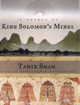
Tahir Shah is the ideal kind of traveler. While I typically explore a foreign country in a comfortable coach bus with other tourists, Shah travels on a camel with a salt caravan. While I am too self-conscious to speak to the locals, Shah hires an entourage of guides, drivers, and porters to accompany him on every adventure. While I have lodged in all-inclusive resorts (enclaves of America and Europe nestled into Mexico or the Dominican Republic), Shah has been imprisoned for weeks in a Pakistani torture chamber.
Well, that’s going a little too far even for my taste. Tahir Shah, one quickly realizes, is not a traveler of the modern mold. He could care less about wine, golf, and seaside massages. In Search of King Solomon’s Mines, his account of travels in Ethiopia, documents Shah’s quest for the source of the legendary treasure from the First Temple in Jerusalem. Shah is not the first to search for the ancient gold mines of Ethiopia, and his manner of conducting his expedition seems almost naive (he got the idea from an obviously-fake treasure map of Ethiopia that he purchased in a Jerusalem marketplace). But while reading the book, one realizes that Shah is not looking to get rich; he is looking for a story. He travels according to the motto, “adventure is only inconvenience rightly understood”. And any adventure is worthwhile if it proves interesting to recall. So getting ripped off by an opportunistic Israeli merchant is no loss. Shah seems to have relished writing about the experience. Even a counterfeit map, in retrospect, can lead one to treasures of a sort.
Counsel against thirst for power
In the Republic, Plato warns us that the pursuit of power and prestige leads to suffering, injustice, and perhaps even death. Living – as some of us are – in comfortable homes and safe neighborhoods, one easily forgets that Plato’s advice is very pertinent to real life. One need only to look at history at some of the most famous cases of worldly ambition to see that striving for power often meets the grizzliest of ends. One such example is that of Beyazit I, an early Ottoman sultan who was also called Yilderim (“Thunderbolt”) because of his notorious spurts of anger. He set out to do what no former Muslim ruler could up to that point – capture the jewel of the eastern Roman world: the city of Constantinople. He came fairly close. The Byzantine empire was fragmented and weak. Beyazit had just crushed at the battle of Nicopolis (1396) an alliance of western European armies sent to thwart the Ottoman advance. Constantinople was for the Thunderbolt’s taking. Beyazit himself was to fulfill a prophecy of Muhammad that a blessed Muslim ruler and army would capture the ancient capital, ensuring his place in history as a hero of Islam. But then, Beyazit’s prize was snatched from his hands and he himself would meet a bitter end. The armies of Tamerlane, one of history’s most famous conquerors, swept in from Central Asia and invaded the territory of the Ottomans. At the battle of Ankara on July 28, 1402, Beyazit’s armies were defeated and he was captured by Tamerlane. Here is how Stephen O’Shea describes Beyazit’s fate in Sea of Faith:
“The Thunderbolt was not as lucky – taken prisoner, he was carted around in a litter, which later legend made into a cage, as Timur sacked the cities of northwestern Turkey that the sultan’s ancestors, Osman and Orhan, had conquered. Apparently, during this campaign Beyazit’s lovely Serbian bride, Olivera [by whom “he was, by many accounts, deeply smitten” when he was getting to know her], was relieved of her clothes and forced to serve, stark naked, at the table of the great Mongol. Beyazit, dejected and humiliated, died the following year” (252, 245).
Hearing about Beyazit’s life, Plato’s advice rings truer. He would have us be like his Odysseus in the Myth of Er at the end of the Republic. For Odysseus – who is in Hades having to choose a new life for himself – “the recollection of former tolls had disenchanted him of ambition, and he went about for a considerable time in search of the life of a private man who had no cares; he had some difficulty in finding this, which was lying about and had been neglected by everybody else; and when he saw it, he said that he would have done the [same] had his lot been first instead of last, and that he was delighted to have it.”
Watershed moments in history
There are events in the past – a few days, hours, or minutes even – which determine the course of history for centuries to come. This statement is banal without adding to it an appreciation for just how arbitrary those fateful moments are at times. On the whim of a general or the passing mood of an army or the momentum of herd mentality, the course of a country’s future can be decided. One such event occurred at the battle of Las Navas de Tolosa in 1212 AD. For five-hundred years prior to the battle, Muslims had shared the Iberian peninsula with Christians in a relationship that ranged from tolerant to brutally violent. At the battle of Las Navas de Tolosa, the Muslim armies were delivered a death blow by the Christian Spaniards united thanks to the saber rattling of Pope Innocent III. Christianity would become the dominant religion in Spain to this day as a result of the battle of Las Navas de Tolosa. But for a few desperate moments on Monday, July 16, 1212, the path of Spanish history hung in the balance. Stephen O’Shea in Sea of Faith writes:
“The day seemed to be going for the caliph. Battle standards wavered in the dust and shouting, as the Christians desperately tried to hold their ground but seemed poised to desert en masse. From his vantage point atop the Mesa del Rey, King Alfonso is supposed to have turned away from the disheartening spectacle and said to Rodrigo Jiménez de Rada, ‘Archbishop, let us die here, you and I'” (226).
The outcome of the battle turned out quite differently. A group of Christian knights from the rear guard thundered into the battle and, almost inexplicably, broke through and routed the whole Muslim army. And the confessional geography of Spain would never be the same again.
Storytelling tricks: connotation
How does a good storyteller narrate a tale? One of a storyteller’s rhetorical tricks, I have noticed, is keeping in mind the connotation of what he is saying or writing. That is, he adds to his narrative phrases that stimulate the imagination and suggest another way of seeing things, though such phrases may not add any new information to the story. A good example I found in Stephen O’Shea’s Sea of Faith: Islam and Christianity in the Medieval Mediterranean World:
“The freed warrior was past thirty, already a ripening age for an ax-man with countries to cleave. Henceforth Karl Martiaux – Charles Martel – would forge a kingdom that covered much of present-day France, western Germany, and the Low Countries. Martel – the name comes from Martin, not marteau (hammer) – embarked on an unrelenting itinerary of violence, forcibly bringing the eastern and western Franks to heel” (62; emphasis added).
The artful passage speaks for itself, but I’ll dissect it anyway. O’Shea adds the parenthetical phrase about Martel’s name to slily suggest that Martel was indeed very hammer-like, even though the literal meaning of the excerpt looks as if O’Shea is trying to dispel this etymology. The reader gains nothing from the author’s tricky penmanship other than a more vivid and enticing portrait of Martel, his character.
 HistoryJournal.org
1 comment