“Song of a Fighter Pilot”
 Vladimir Vysotsky wrote such evocative songs about World War II that it’s impossible to tell that he himself didn’t serve in that conflict. His verse on the theme of friendship is especially amazing.
Because of songs like his and the Russian culture of my upbringing, the symbolism of World War II (or, as the Russians call it, The Great Patriotic War) has stayed with me as a kind of arch-metaphor for the human condition.
I was listening today to one of my favorite songs by Vysotsky called Pesnya lyotchika-istrebitelya: “Song of a Fighter Pilot”. It is one of the greatest poems about friendship that I have ever read, and I decided to translate it into English. My translations skills are limited, but though my version inevitably may have errors, I have done my best to convey both the meaning and the flow of the song. The original, like most Russian poems and songs, has a rhyme scheme.
The song is about two Russian fighter pilots in World War II that find themselves embroiled in a losing battle with a larger German fighter formation. You can listen to the original song on YouTube and read the lyrics in Russian here.
…
Song of a Fighter Pilot
By Vladimir Vysotsky
(Translated by Alex L.)
Eight of them and two of us. Our prospects before battle
Aren’t bright, but we’ve committed to the fight.
Seryozha!* Hold on, it’s looking dim,
But we we have to get an edge in the game. (more…)
History off the press (October ’11 edition)

Swords to plowshares
President Obama recently announced that the United States will recall all of its armed forces personnel from Iraq by the end of 2011. This is a strange outcome for those of us who remember the seemingly insurmountable setbacks created by the insurgency before the 2007 surge of American troops unraveled the extremists’ grip on the country. It was hard to see back then that the situation in Iraq could improve. But it did. The following books explore in a unique way the nature of organized violence in the contemporary world.
…
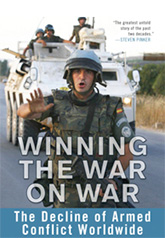 Although we may not realize it from all of the news dispatches dripping with depressing forebodings of disaster either due to economic or glacial meltdown, there are reasons to be optimistic about the current state of the world. Joshua S. Goldstein, in a new book called Winning the War on War: The Decline of Armed Conflict Worldwide, makes the case that the human race is freer from war now than it has ever been. The facts tell a counterintuitive but inspiring story: there are currently no nations at war in the world (only civil wars are going on) and last year had one of the lowest death rates from armed conflict in history.
Along similar lines, Steven Pinker has just published a similar work. Pinker makes the same observation – “we may be living in the most peaceful time in our species’s existence” – but approaches the subject from the perspective of psychology, his field of study, rather than international affairs. Both of these perspectives are worth keeping in mind the next time you hear a pundit on cable news or a sensationalistic author prophesying apocalypse for Western civilization just to get your attention. (more…)
 HistoryJournal.org
3 comments