Many history blogs
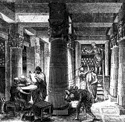 When I started historyjournal.org, I thought there were relatively few people blogging about history. I’ve since learned that there are many such blogs on all kinds of topics. Below are two helpful lists of quality history blogs:
1. Cliopatria’s History Blogroll (Part 1 | Part 2)
2. Top 50 Biblical History Blogs
My current blogroll consists of PaleoJudaica.com (biblical history), Easily Distracted (history and academia), Cliopatria (general history), AHA Blog, and Pedablogue (an awesome blog about pedagogy).
“Dead Sea Scrolls and the Bible” exhibit in Milwaukee
 Milwaukee’s Journal Sentinel has reviewed a new exhibit at the Milwaukee Public Museum called “Dead Sea Scrolls and the Bible”. The reviewer applauds the installation, which features objects from Qumran but also many general artifacts from biblical times.
Looking through the photo slide-show attached to the review, I perceive that the exhibit is laid out according to a new style of exhibit display. When I visited the new Abraham Lincoln Presidential Library and Museum in Springfield, IL a few years ago, I noticed that the museum had chosen a fresh approach to museum design. Instead of overwhelming the viewer with a plethora of artifacts and informational plaques, the museum recreated historical environments in each of its varying rooms. One room was Lincoln’s childhood cabin. Another was his funeral visitation room. Each display was artfully lit, engaging, and informative without being overwhelming.
From what I can tell, this style has caught on and the “Dead Sea Scrolls and the Bible” exhibit appears to be equally refreshing. Perhaps it’s time for me to visit Wisconsin again.
Improv and teaching
 While browsing through blogs about history a few days ago, I read an interesting post on Pedablogue, a blog about the scholarship of teaching, titled, “Whose Class is it Anyway? Presentation on Improv”. The author, Michael Arnzen, has posted the presentation slides from a lecture he delivered about using improvisational acting in the classroom.
The presentation describes a strong case for shaking up the traditional formalism of a classroom by creating an environment where intellectual play by both students and teacher is encouraged. My best experiences as a student have been in classrooms where teachers have had a sense for the drama of the classroom.
There are many benefits to improv in the classroom, as Mr. Arnzen points out. One interesting point he made was that improv allows for a temporary suspension of status roles: if the teacher can playfully relinquish the power role in the improv atmosphere he creates, then the students feel more comfortable participating in class.
Mr. Arnzen does not address whether improv in the classroom would be a formal event that the teacher plans (“Tomorrow, we will be acting in class…”) or whether he meant continuous and unannounced intention on the part of the teacher to make his or her classroom a more intellectually playful environment. I think the mark of a good teacher is if he can perform the latter role well.
“WWII in HD” — transformative and balanced
 Gone are the days when the History Channel disproportionately focused on programs about World War II instead of disproportionately fixating on Bigfoot and Mayan prophecies. Until now. History Channel has a new series which stands apart from the network’s bizarre trend of shows about UFOs, astrology, and monster-hunters. “WWII in HD”, a throwback to History Channel’s roots, is a truly innovative series.
“WWII in HD” features almost exclusively rare color war footage. The effect of this is to enliven the 1940s. It feels like watching film from the Vietnam War, which seems more “real” to me because I associate it with color.
The other outstanding element about this series is the dialogue. The show follows twelve American men and women during their service in the war. They are interviewed as elderly veterans, but when the war footage is shown, the interviews transition into voice-overs by younger men and women. This technique is elegantly executed and makes you aware that these aged heroes of an inaccessible age were once the youth of the world. The dialogue is poignant, and the transitional phrases especially are epic.
Finally, the most lasting impression of the series is the footage of carnage. I have heard veterans speak of that shocking aspect of war – the odor of burning flesh, bodies thickly littering the battlefield, disfigured faces. But hearing about it—no matter how vividly told—can not compare to seeing it in color. Short of smelling the awful stench of war, “WWII in HD” portrays the nauseating reality of indiscriminate and grotesque death in battle.
In one episode, President Franklin Roosevelt asks a war correspondent whether he should allow a documentary film about the Battle of Tarawa to be show uncensored to the American public. The reporter, who had been embedded with the Marines in combat, replied that the soldiers wanted the civilians back home to know that the war was not all about victory and glory. The documentary, which featured graphic portrayals of combat, went on to win an Academy Award and significantly increased the sale of war bonds. Like “With the Marines at Tarawa”, “WWII in HD” is a transformative and balanced memorial to the Second World War.
My memories of the end of the Cold War
 In the early 1990s, Russian-Americans joked that bananas were the national food of Russia, because newly arrived Russian immigrants to America would eat them zealously and in abundance. Of course, quite the opposite was true. Bananas were scarce in the Soviet Union so Russians who moved to Western countries were simply making up for lost time. My parents like to remember that shortly after our family’s arrival to the United States, I declared, “I will never get sick of bananas!”
That was the end of 1992, and I was seven years old. Since then, years of consuming banana slices with morning cereal or in cafeteria fruit medleys have eroded my—and perhaps most Russian-Americans’—enthusiasm for the fruit. Time heals all wounds and also dissipates all wonder. On November 9, 1989, the Iron Curtain was lifted, and for the first time in decades, East Germans crossed over the Berlin Wall, which would be dismantled in the weeks that followed. I don’t remember any of this, as I was only four years old. The only political events I remember appreciating while I lived in the Soviet Union were the inflation of the Soviet (then Belarusian) currency and Mikhail Gorbachev’s house arrest in August 1991. He graciously waved to me through the television screen in my grandparents’ living room and was worried, a journalist said, about his political enemies poisoning his food as they held the country hostage for four days. I was impressed by his calmness.
This is all I remember, though, of what the Economist recently described as the “most remarkable political event of most people’s lives . . . [which] set free millions of individuals and . . . brought to an end a global conflict that threatened nuclear annihilation.” I was young and years of living in the United States have made the Soviet Union, the Cold War, and Gorbachev memories from another lifetime. But this morning, twenty years to the day when the Iron Curtain fell, my father and I ceremoniously split a banana in two and each ate a half, savoring every bite.
“In Search of King Solomon’s Mines” by Tahir Shah
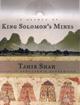
Tahir Shah is the ideal kind of traveler. While I typically explore a foreign country in a comfortable coach bus with other tourists, Shah travels on a camel with a salt caravan. While I am too self-conscious to speak to the locals, Shah hires an entourage of guides, drivers, and porters to accompany him on every adventure. While I have lodged in all-inclusive resorts (enclaves of America and Europe nestled into Mexico or the Dominican Republic), Shah has been imprisoned for weeks in a Pakistani torture chamber.
Well, that’s going a little too far even for my taste. Tahir Shah, one quickly realizes, is not a traveler of the modern mold. He could care less about wine, golf, and seaside massages. In Search of King Solomon’s Mines, his account of travels in Ethiopia, documents Shah’s quest for the source of the legendary treasure from the First Temple in Jerusalem. Shah is not the first to search for the ancient gold mines of Ethiopia, and his manner of conducting his expedition seems almost naive (he got the idea from an obviously-fake treasure map of Ethiopia that he purchased in a Jerusalem marketplace). But while reading the book, one realizes that Shah is not looking to get rich; he is looking for a story. He travels according to the motto, “adventure is only inconvenience rightly understood”. And any adventure is worthwhile if it proves interesting to recall. So getting ripped off by an opportunistic Israeli merchant is no loss. Shah seems to have relished writing about the experience. Even a counterfeit map, in retrospect, can lead one to treasures of a sort.
This Day in History: Nazi Germany invades the Soviet Union
On June 22, 1941, Nazi German armies invaded the Soviet Union, catching the Red Army by surprise and destroying thousands of Soviet airplanes before they even had a chance to take off from the ground. The ensuing battle, known as Operation Barbarossa, lasted until the winter of that year and, according to Wikipedia, “remains the largest military operation, in terms of manpower, area traversed, and casualties, in human history.” I read a few articles (you can tell from which impeccably-reliable source) today about this event and learned a few interesting points.
The mainstream scholarly view of the invasion holds that the Germans caught Joseph Stalin completely by surprise, which explains the heavy Soviet casualties in the beginning of the campaign. A Russian author, Viktor Suvorov, has recently challenged this traditional view with a theory that the Soviets were actually planning an invasion of Germany in 1941 but were beaten to the offensive. This is an ongoing debate among scholars, especially since Suvorov’s theory is largely based on circumstantial evidence (for instance, that the Soviets were developing offensive technologies such as this ridiculous-looking flying tank). Another interesting scholarly controversy I encountered was why the conflict on the Eastern Front of World War II is not well known in America. A recent book, The Myth of the Eastern Front: The Nazi-Soviet War in American Popular Culture, tackles this question. Although my reading on the subject of Operation Barbarossa has been brief today, there are many interesting avenues for further study.
Colbert calls for poetry revival
I enjoyed last night’s interview on the Colbert Report of poet Paul Muldoon, especially how Stephen Colbert tried to popularize poetry by reading one of Prof. Muldoon’s works, “Tea”. As Colbert mentioned, poetry is not cool in today’s America. In a country with a strong democratic spirit, perhaps it seems like an artifact of antiquated aristocratic habits. Quote a poem at a social event and you are sure to sound like a snob.
But this decline in popularity is not entirely the public’s fault. I think poetry, like other arts influenced by academia, has evolved to be too cerebral for the public’s taste. And what a shame!
Well-crafted verse, like no other art, has the power to preserve for posterity emotions, the spirit of an age, and even morals. I heard a contemporary scholar criticize Walt Whitman for writing some of his poems in rhyme. But how well Whitman captured the spirit of a historical moment – the national mood upon the assassination of President Lincoln soon after the end of the Civil War – in his rhyming poem “O Captain! My Captain!”! It is rightly so that this poem is remembered above others in the compilation, Memories of President Lincoln, because it not only delivers a powerful message but also does it so pleasurably (one need not overstrain his brain to understand it).
My hope is that poetry does experience a revival. Words beautifully prepared and powerfully spoken are one of life’s greatest joys.
How do we remember D-Day?
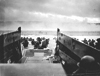 Twelve days ago was the 65th anniversary of the American and British invasion of Nazi-occupied Normandy. The events of June 6, 1944, D-Day, are worthy subject matter for an epic poem by Homer himself. As the ancient Greeks landed on the beach of Asia Minor to lay siege on Troy thousands of years ago, so too the Allied soldiers of World War II disembarked from their landing craft, assaulted the German defense bunkers and machine-gun nests, and began the liberation of continental Europe. The Allies even prepared a Trojan horse of their own: deception programs named Operation Fortitude and Operation Bodyguard fooled the Germans into expecting an Allied amphibious assault in anywhere but Normandy.
How do we in the United States remember D-Day? As an expatriate of the former Soviet Union, I had observed in that country a reverence of its victories during World War II bordering on worship. The business of the Soviet people halted every year for Victory Day; parades, recollection, thanksgiving, military pageantry, and storytelling about the war permeated the land. This is not the way we remember D-Day in America. A few newspaper articles buried underneath other headlines and a visit by President Obama to the military cemetery in France sufficed as our annual memorial of this event. There definitely did not seem to be a national spirit of remembrance.
What story will we tell about this epic day in American history? Will it be a Homeric tale of heroes and timeless deeds? For Christians, do the Scriptures – which ascribe all glory to God – preclude us from remembering it in this way? To forget altogether, due to laziness or otherwise, would be a loss to culture. While recently reading Walt Whitman’s poem about the end of the American Civil War, “Spirit Whose Work is Done”, I thought that his invocation could well apply to the memory of this more recent war:
“[. . .] Spirit of hours I knew, all hectic red one day, but pale as
death next day,
Touch my mouth ere you depart, press my lips lose,
Leave me your pulses of rage – bequeath them to me – fill me
with currents convulsive,
Let them scorch and blister out of my chants when you are
gone,
Let them identify you to the future in these songs.”
Noah’s Ark in the Black Sea: an elegant, if flawed, theory
Sometimes a theory about the past makes for such a good story that it is hard to let go of it, even when it proves to be false. When archaeologist Heinrich Schliemann discovered the ancient Greek city of Mycenae, home of King Agamemnon from Homer’s Iliad, he found a beautiful gold funerary mask of a royal. Imagine, if the mask was of Agamemnon himself, to have a portrait – in gold! – of a hero from Homer’s epic story of the Trojan War, where previously only our imaginations colored those characters. Alas, when the mask was dated, it was pronounced a few generations off from Agamemnon, but how beautiful it would have been if it was his.
Another elegant theory of our past is the Black Sea deluge hypothesis. In 1996, geologists from Columbia University William Ryan and Walter Pitman postulated that a massive flood from the Mediterranean Ocean through the narrow Bosporus strait created the Black Sea as we know it today. Over seven thousand years ago, they said, water burst through the strait and rushed into the Black Sea with force 400 times that of Niagara Falls. Many communities living around the sea were wiped out and the stories told of this catastrophe later became the Great Flood myths in the Hebrew book of Genesis, the Sumerian Epic of Gilgamesh, and other ancient narratives. Finding an archaeological counterpart to the story of Noah’s ark is a tantalizing idea. The famous oceanographer Robert Ballard (who discovered the RMS Titanic on the ocean floor) even led an expedition to the Black Sea to test the Black Sea deluge hypothesis.
Unfortunately, the theory, in light of new evidence, seems to be false. In such a case, one would chuck it from memory, if the idea was not so artful. Hershel Shanks, editor of the Biblical Archeology Review comments (according to an uncited quote on Wikipedia) that “if you want to see the Black Sea flood in Noah’s flood, who’s to say no?” I disagree with Mr. Shanks: one should not believe in faulty scientific theories. But the debunking of the Black Sea deluge hypothesis is nevertheless a buzzkill to the imagination.
 HistoryJournal.org

leave a comment