Canada and the recession

My lovely girlfriend, a Canadian citizen, challenged me to write something about the more northerly part of North America. Since I’ve also wanted to write a post dealing with economics, badabing badaboom: here’s an article about the Canadian economy. I’m not a professional economist but this entry (and future ones like it) are my way of engaging with economic facts and data on my own so I don’t have to rely solely on the opinions of commentators. That’s why I’m counting these entries as part of my “Economics Sandbox”. Please feel free to correct, comment, question, and enlighten.
I was recently surprised to read that Canada was weathering the economic downturn much better than the United States. What does that mean exactly? I looked at some data to get a better idea.
Just looking at GDP growth, it looks like Canada’s economic output was affected in almost exactly the same way as the U.S. economy.

Source: World Bank
But GDP growth is not the only (or even the best) measure of a country’s economic health.When I looked at unemployment rates, it’s clear that America’s labor market has been in worse straits than Canada’s since the recession started in 2008. (more…)
History off the press (November ’11 edition)

Below is a survey of books that were published in the past month or so and look to me like interesting reads (note: I have not actually read these books, and these are previews not reviews).
…
Russia
 My parents’ generation grew up in the Soviet Union reading and owning volumes of classical literature. Despite my parents’ polemics, my friends and I somehow found playing “Sonic the Hedgehog” on the SEGA Genesis video game console when we were younger more compelling than reading James Fenimore Cooper. Where did this cultural gap come from? A new book by Katerina Clark examines how the Soviet fascination with world literature began in the 1930s as Soviet leaders and intellectuals tried to cast Moscow as a cosmopolitan beacon of secular culture for the world. This mindset during the Stalinist era must have, it seems to me, influenced my parents’ generation to become voracious readers.
Soviet life is still a rich field for contemporary historical study and literature. But the Western imagination is more captivated by an earlier time in Russian history: the dynasty of the Romanovs. Robert K. Massie has just published a book titled Catherine the Great: Portrait of a Woman. His previous biography of a Romanov monarch, Peter the Great, won a Pulitzer Prize in 1981. Catherine continued the project begun by Peter of making Russia one of the preeminent nations of Europe and was friends with the likes of Voltaire, Frederick the Great, and even John Paul Jones. Massie’s new work about the most influential female ruler in all of Russian history will likely remain the definitive biography on Catherine for many years. (more…)
History off the press (October ’11 edition)

Swords to plowshares
President Obama recently announced that the United States will recall all of its armed forces personnel from Iraq by the end of 2011. This is a strange outcome for those of us who remember the seemingly insurmountable setbacks created by the insurgency before the 2007 surge of American troops unraveled the extremists’ grip on the country. It was hard to see back then that the situation in Iraq could improve. But it did. The following books explore in a unique way the nature of organized violence in the contemporary world.
…
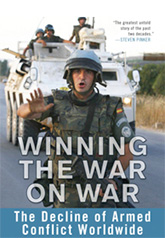 Although we may not realize it from all of the news dispatches dripping with depressing forebodings of disaster either due to economic or glacial meltdown, there are reasons to be optimistic about the current state of the world. Joshua S. Goldstein, in a new book called Winning the War on War: The Decline of Armed Conflict Worldwide, makes the case that the human race is freer from war now than it has ever been. The facts tell a counterintuitive but inspiring story: there are currently no nations at war in the world (only civil wars are going on) and last year had one of the lowest death rates from armed conflict in history.
Along similar lines, Steven Pinker has just published a similar work. Pinker makes the same observation – “we may be living in the most peaceful time in our species’s existence” – but approaches the subject from the perspective of psychology, his field of study, rather than international affairs. Both of these perspectives are worth keeping in mind the next time you hear a pundit on cable news or a sensationalistic author prophesying apocalypse for Western civilization just to get your attention. (more…)
Driving at the speed of flight
 I can’t say I enjoy Jay Leno’s jokes as much as I do the work of Jon Stewart, Stephen Colbert, and David Letterman. But man does the guy have an awesome car collection.
I know next to nothing about vintage car restoration, but I can appreciate a sleek-looking and rumble-producing automobile. When I came across Jay Leno’s video of his 1915 Hispano-Suiza Aero Engine Car restoration (see part 1, part 2 and part 3), though, I almost started drooling. The reason is because the restored car combines in an engaging package some things that, well, just make me salivate like a dog sensing dinner: aviation, World War I history, craftsmanship, and speed.
The 1915 machine is no ordinary automobile. It’s fitted with an engine taken from a World War I fighter airplane. As Wikipedia informed me, after the First World War ended, surplus airplane engines were relatively cheap and vastly more powerful than what cars were then using. Some auto engineers decided not to let this opportunity pass and created cars with automobile chassis and airplane engines. Such aero-engined cars were a brief trend in auto racing during the inter-war period.
The Hispano-Suiza engine is the motor that was used to power the S.E.5, a British fighter plane during World War I. This was the primary aircraft of No. 56 Squadron RFC (Royal Flying Corps), the famous unit of expert flyers and warriors—such as James McCudden, Albert Ball, and Cecil Lewis (the last of whom wrote a now-rare but fascinating and honest memoir of his war years, titled Sagittarius Rising)—who helped defeat the imperial German air force. (more…)
History off the press (September ’11 edition)

Below the fluorescent lights of an auditorium, a professor lectures to students about current historical ideas gleamed from countless of hours of collective research and collegiate debates. A journalist, after decades of reporting on current events in a foreign land, publishes a book about a historical subject she deems particularly important to understanding what is happening there today. A popular film gets released about the past that lights up the public imagination to a certain era of history.
Public recollection of the past happens in many ways. To follow every one of these events, which occur daily, is almost impossible. But patterns emerge from observation, though understanding why they occur is sometimes difficult. In the following previews of new books, I hope to draw attention to trends in the public discourse about history. A more detailed look at the context and causes of these dialogues, though, requires further research.
Fighting to the last
Ever since I first heard the lyrics of Alexander Gorodnitsky’s song “Atlases”, the Siege of Leningrad has become elevated in my mind as an eternal symbol of people’s remarkable ability to endure suffering and emerge victorious. The symbols and metaphors of the song are ingenious. In the famous Hermitage Museum of St. Petersburg, there are sculptures of Atlas from Greek mythology that act as structural columns for a portico . The Soviet men and women who died to stymie the advance of Nazi warriors before Leningrad are, to Gorodnitsky, like the Atlases of the Hermitage, “up-holding the sky / with arms of stone”. (more…)
History off the press (August ’11 edition)

Have your relatives ever told you stories about your ancestors that made you reevaluate your own identity? My grandmother once told me that her father (my great-grandfather) possessed a mellifluous voice and staged concerts for his fellow Allied soldiers imprisoned in a German POW camp during World War I. Hearing this story, it made me question how genetic quality could dissipate so quickly, for my vocal chords can’t produce a single melodic note if my family’s honor depended on it.
Like talking to our grandparents about departed relatives, reading history can change our perspective about our own selves or our community. I selected the books for August (remember, these are previews, not reviews: I have not read these books yet) that drew me in either because they addressed a need for self-knowledge or promised to inform me about the world around me. As a result, almost of them, I noticed later, have to do with U.S. history. But I think our subjectivity is what lights our interest afire. Our bias is our personality, and without it history narratives wither before us like dehydrated fruit.
New York City roots
For several months, I’ve had an itch to discover “literary” neighborhoods in Chicago. Seeking counsel, I asked fellow Chicagoans (full disclosure: I live in the suburbs, not the city proper) where writers live or congregate in the Windy City. No one had an answer, which made me despair that the only destination for writers in the United States was prohibitively-expensive Manhattan. (more…)
History off the press (July ’11 edition)
 One of my favorite things about reading good history books is that it changes the way you see your environment. Familiar places become more exciting, strangers begin to seem more intriguing, traveling becomes a richer experience, and, if you’re lucky, some of one’s ignorant assumptions are challenged and replaced with insights. It’s like discovering again the sense of wonder about the world that we all had as kids.
The new history books published in late June and early July of this year promise to stretch our minds and offer us to look upon our world with new, unwearied eyes. As I mentioned in the first “History Off the Press” post last month, the books I will feature here were or will be published in late June or July; this list is neither exhaustive nor objective; and I have as yet read none of these publications (except for maybe a preview of the first few pages on Amazon.com).
Rivals of the ancient world
Without imagination, historical evidence seems dull and tragic. We can’t help but feel a patronizing condescension toward our ancestors, whose eroded remains of buildings look like something a child sculpted from sand on a beach and whose stories and myths sound like the imaginings of acid trippers or chauvinistic patriarchs or both.
What I like about Andrea Carandini’s new book, Rome: Day One, is his almost playful combination of taking ancient myths seriously and using colorful narrative writing to vivify the ruins of the ancient imperial city in Rome. Carandini uses the archaeological evidence to argue that the myth of the founding of Rome by Romulus is not far from the truth, that “a king whose name might have been Romulus founded Rome one April 21st in the mid-eighth century BC, most likely in a ceremony in which a white bull and cow pulled a plow to trace the position of a wall marking the blessed soil of the new city.” (more…)
Checking the stove, checking it twice
 No matter how late I’m running for an appointment or how urgently I need to put my shoes on and exit the house now, I always have time before I leave to check the stove… twice.
No, there’s nothing wrong with the appliance. The stove/oven range sits snuggly embedded inside of a curving pathway of granite countertop and contends favorably with the dishwasher for the title of swankiest object in the kitchen. It has no known malfunctions.
What I’m interested in is making sure that, before I leave the house, I haven’t left the stove “on”. It just takes two (on rare occasions, three) separate trips within the span of about two minutes for me to be really convinced of the stove’s neutrality.
I’ve grown used to this habit, but the irrationality of repeating this rite at least once a day has its own consequences. The Stove has acquired powers of awful proportions. One burner left carelessly open during the course of a workday, and the entire house – my laptop, my Kindle, my papers, my books, my musical instruments, my pets, my paperwork – will be licked away by property-destroying flames (or so I think). The stove represents a solitary seed of chaos-potential in the otherwise predictable routine of life.
So it must be monitored with the care that one reserves for an errant child with a bent toward pyromania. And if one has to swing through the kitchen an extra time because one wasn’t convinced that one sufficiently scrutinized the status of every burner knob (including the slow-cooker’s) the first time, then it’s a necessary evil. (more…)
Symbolic reactions
 In the deserts of the Middle East, goatskin seems to have been the material of choice for transporting water. This seemed strange to me when I first read about it in Wilfred Thesiger’s account of his travels in the sands of the Arabian Peninsula with the Bedouins. The way he described it, it seemed these goatskins had a tendency to sweat in the blistering sun and tear and leak their irreplaceable cargo as the nomads traveled from well to well.
Thesiger’s narrative formed images in my mind: the goatskin containers bulging with water and bouncing on a camel’s back; moisture congealing on the skins and falling in small droplets to sizzle on the sand; the Bedouins (and Thesiger with them) drinking gladly the animal-scented liquid at the end of a long day’s ride. Soon these water-bearing goatskins became for me part of a larger symbolism that I had affixed to the Bedouin lifestyle.
The nomadic Arabs were a complex people in Thesiger’s account. Ready to drive a knife through the chest of a child from a competing tribe if the customs of a blood-feud demanded it, the same Bedouin man would literally give the last shirt off his back or the last swigs of camel’s milk to a stranger who happened upon his camp. To me, reading and re-reading Thesiger’s book, Bedouins came to represent a love of freedom, a fraternal devotion to clan, and a proud contentedness with simple living.
But I have never met any real Bedouins (I’m not counting the hospitable entertainers of Bedouin descent who served coffee and rice for our Birthright Israel group before returning to their mansion in the desert for the night). Bedouins, along with their goatskin water bottles that I have never actually seen, exist only in my mind as symbol and metaphor. (more…)
History off the press (June ’11 edition)
 There are perhaps hundreds, if not thousands, of books about historical subjects published every month. This is counting neither the books in foreign languages nor the voluminous scholarly and journalistic articles about history. Trying to follow almost any trend in our well-connected world is a laborious process, and keeping track of newly-published history books is no exception.
What helps me is keeping in mind that history books are not published in a cultural vaccuum. Behind almost every good history publication, there is a continuation going on of a fragmented communal dialogue about the subject. That is, the author is responding to some ideas and stories that previous authors had written about the same historical topic. Sometimes the author may present an argument that contradicts most of what other authors had written before him. At other times, history books are written more in an expository rather than a persuasive style. But all too many history publications are dreadfully boring because the communal discussion about a topic – especially in the community of professional historians – has taken a turn for the “who cares?”
Personally, there are two main qualities that I really prize in a book of history. These are when an author:
- Chooses in writing his book to respond to a historical discussion that is intriguing and insightful, and
- Writes in a style that makes a skillful and effective use of narrative.
In this post, I will feature some history books published in May and early June of 2011 that seem like good reads. I came up with this list by browsing the Web for new releases and then evaluating their quality based on the books’ description and reader reviews. I found samples from new books rarely available online, so admittedly some of these authors’ writing styles may actually turn out to be terrible. Needless to say this list is subjective and not comprehensive, but my goal is to add some kinds of grains of context to new first-editions of history. Let’s begin with books about a topic I’ve written about recently: travel and exploration. (more…)
 HistoryJournal.org

leave a comment