New history books (April 2012 edition)

Below is a survey of books that were published in the past month or so and look to me like interesting reads (note: I have not actually read these books yet, and these are previews not reviews).
Russia
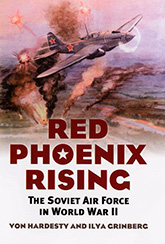 Readers of this blog may notice that my interests have lately been skewed toward the world wars (in particular the air and naval conflicts). When I was a boy my imagination was fired up by stories from my grandfather, who told me about his service as an aviator for the Soviet Navy during the Second World War. I suspect this was when I first became interested in history (I also remember my grandfather reading me a children’s book about the ancient origins of everyday objects, such as matchsticks and clothing irons). Stories about pilots during World War II were my Iliad and Odyssey: they helped me understand concepts such as friendship and courage when I was very young.
That’s why it’s particularly disappointing that there is hardly anything written in English about the air war on the Eastern Front during World War II. The struggle for dominance in the skies over Eastern Europe between 1941 and 1945 was the largest and longest air campaign in history according to amateur historian Christer Bergström (whose two sets of books about this conflict — Black Cross/Red Star and The Air Battle series — are some of the only comprehensive histories in English on the subject). That’s why I was eagerly awaiting the release in late March of a new book by Von Hardesty and Ilya Grinberg, titled Red Phoenix Rising: The Soviet Air Force in World War II. An overhaul of a previous work, Red Phoenix Rising will hopefully do justice to the drama and significance of this struggle (Bergström’s works, if meticulous, are admittedly dry to read). (more…)
New history books (March 2012 edition)
Below is a survey of books that were published in the past month or so and look to me like interesting reads (note: I have not actually read these books yet, and these are previews not reviews).
…
Soldiers’ stories
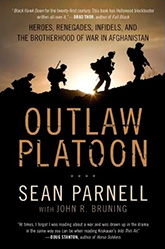 Great books temporarily lend the reader a new set of senses to experience a different reality. Sometimes as readers we recognize the types of books that propel us into a world that we have learned to enjoy, and we crave this release. Often I want to read military memoirs and observe how courageous individuals dealt with extreme adversity in moments of intense pressure. Of course I am witnessing their stories from a comfortable distance (often from a comfortable couch too) but then again I wouldn’t want to actually go through what those soldiers did firsthand. I just finished reading Tom Johnson’s excellent memoir, To the Limit, about his service as a Huey helicopter pilot in the Vietnam War. It gave me — a fixed-wing aviation buff — a newfound appreciation for the skill and warrior spirit of military helicopter pilots.
In February, Vietnam veteran Philip Keith published a book about a unit of tank troops in Vietnam — part of the Blackhorse Regiment — that responded to a distress call from an encircled company of American infantry. This group of men who fought through the enemy-held jungle to rescue their countrymen was not publicly recognized for their courageous deeds until 2009 when President Obama awarded their outfit the Presidential Unit Citation. Accounts of tank combat are inexplicably rare and Keith’s seems like an engrossing one. (more…)
New history books (February 2012 edition)

Below is a survey of books that were published in the past month or so and look to me like interesting reads (note: I have not actually read these books yet, and these are previews not reviews).
…
Russia
 No one in the world was surprised that Vladimir Putin was elected President of the Russian Federation yet again this year. News about Russian opposition movements — none too threatening to Putin’s grip on Russia — has been featured on the front pages of the Western press for the past couple of months. As that nation seems to be tragically slinking back into old habits of autocracy, historians have been looking to Russia’s past to find success stories when moderating forces opposed corrupt centralization of power. The primary question these historians seem to be asking is this: is autocracy inevitable in Russia?
A classic work of this type is Victor Leontovitsch’s The History of Liberalism in Russia, which was published in English for the first time this January (it was written in German and first released in 1957). In May of last year, Julia Berest published a biographical account of one of Russia’s early liberals during the Napoleonic era: Alexander Kunitsyn. A more recent contribution to the debate will be published in June of this year by the university press of my alma mater: the University of Wisconsin. Anton A. Fedyashin’s Liberals under Autocracy: Modernization and Civil Society in Russia, 1866-1904 utilizes the history of Russia’s primary liberal journal before the 1917 revolution, The Herald of Europe (Vestnik Evropy) as a lens into what he sees as a uniquely Russian brand of liberalism. (more…)
Art and moral courage
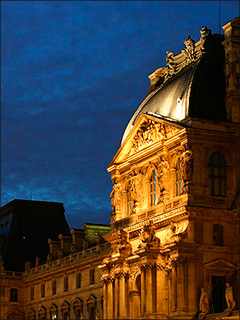 Does being an atheist mean you have to be non-religious, asks popular philosophy writer Alain de Botton? In a new book and in an interview on the podcast Philosophy Bites, he answers that atheists should give certain religious practices a second look.
Himself an atheist, de Botton argues these points in the interview: (1) it’s easy for people of all beliefs to forget moral lessons they’ve learned in the past and continue repeating their mistakes, (2) religions do a good job of creating a “moral atmosphere” that inspires people to think about goodness, evil, suffering, and kindness; (3) art museums should organize at least some of their galleries not chronologically but thematically, taking inspiration from church services that through the senses invite the viewer to consider moral and ethical questions; and (4) atheists should adopt for themselves ideas that they like from any religion just like one may both like and dislike certain parts of the same work of literature.
Can going to a museum make one morally courageous? I agree with de Botton’s first proposition, and I also think that art can remind us of our values. For me, narrative-centered art forms like film, literature, and biography have the strongest impact on reinforcing my beliefs (or challenging them, for that matter). Static forms of art (like painting) or highly stylized ones (like opera) are more difficult for me to apply to my life. Even though I still enjoy them, I lack a mental paradigm to delve into their truths. Music, poetry, and philosophy writing break down for me in the middle: the more their arguments and observations are delivered in a narrative form, the more I am capable of thinking seriously about them. (more…)
That constitution is best which…
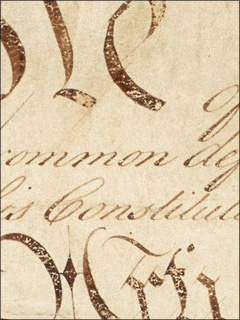 An upcoming study in the New York University Law Review finds that the U.S. Constitution is losing favor as a model for new constitutions around the world, reports the New York Times. Since the 1960s and 1970s, when the American document witnessed its height of popularity, foreign governments have turned to more progressive constitutions such as the Canadian Charter of Rights and Freedoms for inspiration.
The N.Y. Times article suggests three reasons for the decline in popularity worldwide of our Constitution: (1) America’s decreasing influence and reputation, (2) conservative judges’ insistence that the original intent of the Founding Fathers be considered in rulings, and (3) the absence of rights that are featured in other nations’ constitutions (e.g. rights to travel, food, education, and healthcare).
Should these be causes for concern for Americans?
Addressing the first reason, I think the greatest blows to American reputation happen when the U.S. initiates wars of questionable cause. American involvement in Vietnam and Iraq (2003-2011) soured America’s image around the world during a time when we needed support for broader conflicts (Cold War and the War on Terror, respectively). We should become more wary of beginning a war. (more…)
New history books (January 2012 edition)

Below is a survey of books that were published in the past month or so and look to me like interesting reads (note: I have not actually read these books yet, and these are previews not reviews).
…
War of 1812
 This year marks the 200th anniversary of the War of 1812. Many overlook this conflict, but it inaugurated important changes for America. During the war, America tried unsuccessfully to invade Canada, Washington D.C. was invaded and burned by the British, American Indian unification efforts (which were supported by the British) against the colonists were dealt a punishing blow, and the lyrics of the “Star Spangled Banner” were composed. After the war, British and American relations began to improve until eventually the two nations became each other’s closest ally in the 20th Century.
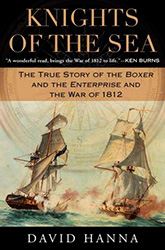
Several new books are being published in commemoration of the anniversary. Three that were released last year—two popular ones by George C. Daughan and Stephen Budiansky and a more scholarly one by Kevin D. McCranie—focus on the naval conflict. But the best new overview of the War of 1812 is by J.C.A. Stagg and is due to come out on March 31 of this year.
The book I’m most excited to read, though, is David Hanna’s Knights of the Sea: The True Story of the Boxer and the Enterprise and the War of 1812. The ships HMS Boxer and USS Enterprise dueled off the coast of Maine on a brisk autumn day. The captains of the opposing vessels were later buried together in a dual funeral on the American shore, inspiring the poem “My Lost Youth” by Henry Wadsworth Longfellow. (more…)
Memoirs of a Russian submariner
 In high school English class, I was taught about the three general types of conflict that one may encounter in literature: Man vs. Nature, Man vs. Man, and Man vs. Self. Memoirs from combatants of the Second World War are often as exciting to read as literature because all three types of conflict figure into them on a grand scale. But there is a fourth type of conflict that we didn’t learn about in class but which, particularly for the men and women of the Soviet armed forces, added that extra dimension of drama: Man vs. Machine.
The nation that brought the world Lada and Zhiguli cars–which asked of their owners to spend nearly every weekend under their jacked-up chassis salving their ever-irritated metal bowels–produced submarines during WWII that would never quite pass muster in an American or German shipyard. This run-down state of submersible machinery can be fully appreciated by reading Victor Korzh’s memoir, Red Star Under the Baltic: A Soviet Submariner in WWII.
As the chief engineer aboard these subs, Korzh knew every nut and bolt and describes their mechanical failures with the technical detail befitting a master. But the inability of Soviet designers and shipyards to perfect submarine design is no stain on the reputation of the Russian sailor. On the contrary, the Russian submariners’ ability to not only survive but also sink many German merchantmen in the unforgiving seas of the Baltic is a testament to their boldness and technical ingenuity. (more…)
Love of art in the Siege of Leningrad

This first of a series of posts, called “In the Abstract”, are ideas for topics for new history books. Sometimes historians, I think, shoot themselves in the foot by framing their research projects in an uninteresting way. Others, though, do this masterfully and create history books that are engaging, relevant, insightful, and bring the characters and world of another age to life not only for the academic community but for the general public too. Often the path of success or failure begins in the choice of topic. In an effort to sharpen my skills in framing historical topics, I welcome your criticism and comments of my imaginary abstract.
…
ART is frequently seen as flourish to life for those that can afford leisurely activities. Love of art is something that supposedly dies in people when other, more basic, human needs are not being met. But to a select group of Russian writers, poets, artists, and musicians that lived in Leningrad during the siege of 1941-44 by the German army, the drive to produce new creative work did not vanish. Amid the base struggle for survival in that city under blockade, with starvation, violence, death, cannibalism, terror, and inhumanity permeating their existence, many artists in Leningrad later wrote that they experienced the strongest artistic drive of their lives. There has not been a book in English devoted to their stories. A book about the individuals, meeting places, and creative works that these artists produced (among them Dmitri Shostakovich’s Symphony No. 7–the “Leningrad Symphony”) under the most unpromising circumstances would be a testament to the basic importance of creativity in human life.
History off the press (December ’11 edition)

Below is a survey of books that were published in the past month or so and look to me like interesting reads (note: I have not actually read these books, and these are previews not reviews).
…
Africa
 I’m currently reading William L. Shirer’s The Rise and Fall of the Third Reich, and one of among many striking things about Nazi Germany is how easily a multitude of religious leaders in that country kowtowed to Hitler’s religious decrees (which needless to say were staggering in their impiety—replacing the Bible in pulpits with Mein Kampf, for instance). Religions like Christianity derive their power from writing and oratory. But if those mesmerizing words are not backed by deeds when the going gets rough (i.e. when the Gestapo will kill you if you continue practicing authentic Christianity) then such sermonizing appears in hindsight like idle chatter.
That’s why I can’t help but admire a guy like Sam Childers. After he converted to Christianity, he traded a life of drugs, motorcycle gangs, and chasing women in America to become a machine-gun armed protector of orphans and other destitute children in violence-ravaged Sudan. That’s some tough, in-your-face Christianity and not of the “Have you heard the Good Word? Here, take a pamphlet” variety. Childers has published a memoir of his experiences. (more…)
“Song of a Fighter Pilot”
 Vladimir Vysotsky wrote such evocative songs about World War II that it’s impossible to tell that he himself didn’t serve in that conflict. His verse on the theme of friendship is especially amazing.
Because of songs like his and the Russian culture of my upbringing, the symbolism of World War II (or, as the Russians call it, The Great Patriotic War) has stayed with me as a kind of arch-metaphor for the human condition.
I was listening today to one of my favorite songs by Vysotsky called Pesnya lyotchika-istrebitelya: “Song of a Fighter Pilot”. It is one of the greatest poems about friendship that I have ever read, and I decided to translate it into English. My translations skills are limited, but though my version inevitably may have errors, I have done my best to convey both the meaning and the flow of the song. The original, like most Russian poems and songs, has a rhyme scheme.
The song is about two Russian fighter pilots in World War II that find themselves embroiled in a losing battle with a larger German fighter formation. You can listen to the original song on YouTube and read the lyrics in Russian here.
…
Song of a Fighter Pilot
By Vladimir Vysotsky
(Translated by Alex L.)
Eight of them and two of us. Our prospects before battle
Aren’t bright, but we’ve committed to the fight.
Seryozha!* Hold on, it’s looking dim,
But we we have to get an edge in the game. (more…)
 HistoryJournal.org
leave a comment