History off the press (November ’11 edition)

Below is a survey of books that were published in the past month or so and look to me like interesting reads (note: I have not actually read these books, and these are previews not reviews).
…
Russia
 My parents’ generation grew up in the Soviet Union reading and owning volumes of classical literature. Despite my parents’ polemics, my friends and I somehow found playing “Sonic the Hedgehog” on the SEGA Genesis video game console when we were younger more compelling than reading James Fenimore Cooper. Where did this cultural gap come from? A new book by Katerina Clark examines how the Soviet fascination with world literature began in the 1930s as Soviet leaders and intellectuals tried to cast Moscow as a cosmopolitan beacon of secular culture for the world. This mindset during the Stalinist era must have, it seems to me, influenced my parents’ generation to become voracious readers.
Soviet life is still a rich field for contemporary historical study and literature. But the Western imagination is more captivated by an earlier time in Russian history: the dynasty of the Romanovs. Robert K. Massie has just published a book titled Catherine the Great: Portrait of a Woman. His previous biography of a Romanov monarch, Peter the Great, won a Pulitzer Prize in 1981. Catherine continued the project begun by Peter of making Russia one of the preeminent nations of Europe and was friends with the likes of Voltaire, Frederick the Great, and even John Paul Jones. Massie’s new work about the most influential female ruler in all of Russian history will likely remain the definitive biography on Catherine for many years. (more…)
History off the press (October ’11 edition)

Swords to plowshares
President Obama recently announced that the United States will recall all of its armed forces personnel from Iraq by the end of 2011. This is a strange outcome for those of us who remember the seemingly insurmountable setbacks created by the insurgency before the 2007 surge of American troops unraveled the extremists’ grip on the country. It was hard to see back then that the situation in Iraq could improve. But it did. The following books explore in a unique way the nature of organized violence in the contemporary world.
…
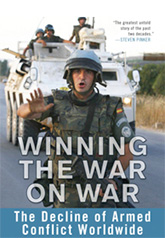 Although we may not realize it from all of the news dispatches dripping with depressing forebodings of disaster either due to economic or glacial meltdown, there are reasons to be optimistic about the current state of the world. Joshua S. Goldstein, in a new book called Winning the War on War: The Decline of Armed Conflict Worldwide, makes the case that the human race is freer from war now than it has ever been. The facts tell a counterintuitive but inspiring story: there are currently no nations at war in the world (only civil wars are going on) and last year had one of the lowest death rates from armed conflict in history.
Along similar lines, Steven Pinker has just published a similar work. Pinker makes the same observation – “we may be living in the most peaceful time in our species’s existence” – but approaches the subject from the perspective of psychology, his field of study, rather than international affairs. Both of these perspectives are worth keeping in mind the next time you hear a pundit on cable news or a sensationalistic author prophesying apocalypse for Western civilization just to get your attention. (more…)
Driving at the speed of flight
 I can’t say I enjoy Jay Leno’s jokes as much as I do the work of Jon Stewart, Stephen Colbert, and David Letterman. But man does the guy have an awesome car collection.
I know next to nothing about vintage car restoration, but I can appreciate a sleek-looking and rumble-producing automobile. When I came across Jay Leno’s video of his 1915 Hispano-Suiza Aero Engine Car restoration (see part 1, part 2 and part 3), though, I almost started drooling. The reason is because the restored car combines in an engaging package some things that, well, just make me salivate like a dog sensing dinner: aviation, World War I history, craftsmanship, and speed.
The 1915 machine is no ordinary automobile. It’s fitted with an engine taken from a World War I fighter airplane. As Wikipedia informed me, after the First World War ended, surplus airplane engines were relatively cheap and vastly more powerful than what cars were then using. Some auto engineers decided not to let this opportunity pass and created cars with automobile chassis and airplane engines. Such aero-engined cars were a brief trend in auto racing during the inter-war period.
The Hispano-Suiza engine is the motor that was used to power the S.E.5, a British fighter plane during World War I. This was the primary aircraft of No. 56 Squadron RFC (Royal Flying Corps), the famous unit of expert flyers and warriors—such as James McCudden, Albert Ball, and Cecil Lewis (the last of whom wrote a now-rare but fascinating and honest memoir of his war years, titled Sagittarius Rising)—who helped defeat the imperial German air force. (more…)
History off the press (September ’11 edition)

Below the fluorescent lights of an auditorium, a professor lectures to students about current historical ideas gleamed from countless of hours of collective research and collegiate debates. A journalist, after decades of reporting on current events in a foreign land, publishes a book about a historical subject she deems particularly important to understanding what is happening there today. A popular film gets released about the past that lights up the public imagination to a certain era of history.
Public recollection of the past happens in many ways. To follow every one of these events, which occur daily, is almost impossible. But patterns emerge from observation, though understanding why they occur is sometimes difficult. In the following previews of new books, I hope to draw attention to trends in the public discourse about history. A more detailed look at the context and causes of these dialogues, though, requires further research.
Fighting to the last
Ever since I first heard the lyrics of Alexander Gorodnitsky’s song “Atlases”, the Siege of Leningrad has become elevated in my mind as an eternal symbol of people’s remarkable ability to endure suffering and emerge victorious. The symbols and metaphors of the song are ingenious. In the famous Hermitage Museum of St. Petersburg, there are sculptures of Atlas from Greek mythology that act as structural columns for a portico . The Soviet men and women who died to stymie the advance of Nazi warriors before Leningrad are, to Gorodnitsky, like the Atlases of the Hermitage, “up-holding the sky / with arms of stone”. (more…)
History off the press (August ’11 edition)

Have your relatives ever told you stories about your ancestors that made you reevaluate your own identity? My grandmother once told me that her father (my great-grandfather) possessed a mellifluous voice and staged concerts for his fellow Allied soldiers imprisoned in a German POW camp during World War I. Hearing this story, it made me question how genetic quality could dissipate so quickly, for my vocal chords can’t produce a single melodic note if my family’s honor depended on it.
Like talking to our grandparents about departed relatives, reading history can change our perspective about our own selves or our community. I selected the books for August (remember, these are previews, not reviews: I have not read these books yet) that drew me in either because they addressed a need for self-knowledge or promised to inform me about the world around me. As a result, almost of them, I noticed later, have to do with U.S. history. But I think our subjectivity is what lights our interest afire. Our bias is our personality, and without it history narratives wither before us like dehydrated fruit.
New York City roots
For several months, I’ve had an itch to discover “literary” neighborhoods in Chicago. Seeking counsel, I asked fellow Chicagoans (full disclosure: I live in the suburbs, not the city proper) where writers live or congregate in the Windy City. No one had an answer, which made me despair that the only destination for writers in the United States was prohibitively-expensive Manhattan. (more…)
History off the press (July ’11 edition)
 One of my favorite things about reading good history books is that it changes the way you see your environment. Familiar places become more exciting, strangers begin to seem more intriguing, traveling becomes a richer experience, and, if you’re lucky, some of one’s ignorant assumptions are challenged and replaced with insights. It’s like discovering again the sense of wonder about the world that we all had as kids.
The new history books published in late June and early July of this year promise to stretch our minds and offer us to look upon our world with new, unwearied eyes. As I mentioned in the first “History Off the Press” post last month, the books I will feature here were or will be published in late June or July; this list is neither exhaustive nor objective; and I have as yet read none of these publications (except for maybe a preview of the first few pages on Amazon.com).
Rivals of the ancient world
Without imagination, historical evidence seems dull and tragic. We can’t help but feel a patronizing condescension toward our ancestors, whose eroded remains of buildings look like something a child sculpted from sand on a beach and whose stories and myths sound like the imaginings of acid trippers or chauvinistic patriarchs or both.
What I like about Andrea Carandini’s new book, Rome: Day One, is his almost playful combination of taking ancient myths seriously and using colorful narrative writing to vivify the ruins of the ancient imperial city in Rome. Carandini uses the archaeological evidence to argue that the myth of the founding of Rome by Romulus is not far from the truth, that “a king whose name might have been Romulus founded Rome one April 21st in the mid-eighth century BC, most likely in a ceremony in which a white bull and cow pulled a plow to trace the position of a wall marking the blessed soil of the new city.” (more…)
History off the press (June ’11 edition)
 There are perhaps hundreds, if not thousands, of books about historical subjects published every month. This is counting neither the books in foreign languages nor the voluminous scholarly and journalistic articles about history. Trying to follow almost any trend in our well-connected world is a laborious process, and keeping track of newly-published history books is no exception.
What helps me is keeping in mind that history books are not published in a cultural vaccuum. Behind almost every good history publication, there is a continuation going on of a fragmented communal dialogue about the subject. That is, the author is responding to some ideas and stories that previous authors had written about the same historical topic. Sometimes the author may present an argument that contradicts most of what other authors had written before him. At other times, history books are written more in an expository rather than a persuasive style. But all too many history publications are dreadfully boring because the communal discussion about a topic – especially in the community of professional historians – has taken a turn for the “who cares?”
Personally, there are two main qualities that I really prize in a book of history. These are when an author:
- Chooses in writing his book to respond to a historical discussion that is intriguing and insightful, and
- Writes in a style that makes a skillful and effective use of narrative.
In this post, I will feature some history books published in May and early June of 2011 that seem like good reads. I came up with this list by browsing the Web for new releases and then evaluating their quality based on the books’ description and reader reviews. I found samples from new books rarely available online, so admittedly some of these authors’ writing styles may actually turn out to be terrible. Needless to say this list is subjective and not comprehensive, but my goal is to add some kinds of grains of context to new first-editions of history. Let’s begin with books about a topic I’ve written about recently: travel and exploration. (more…)
Two-year anniversary
 One way to measure the success of a blog is by how much spam its WordPress filters catch. Somehow, I think the bots that troll the blogosphere know which blogs get more traffic and target their “marketing” strategy at them. The blog that I keep at work, where keywords and headings are meticulously crafted to optimize hits from the search engines, is visited as often as Don Corleone on “this, the day of his daughter’s wedding” in comparison to this, my personal blog. Each day nets dozens of spam comments in my work blog’s filter. HistoryJournal.org, on the other hand, is lucky if the errant male-enhancement ad washes up on shore once or twice a week. I don’t care. Not search-engine-optimizing my
 <h2> tags on HistoryJournal.org is my rebellion against marketing, my current profession.
(Yes, folks. This is the one day of the year, my blog’s anniversary – it was technically on March 8 – where I blog about blogging. Feel free to turn away. There is not so much a sign of a blog’s decay, writer’s block, or an author’s sickness of the writing craft as when he or she begins to write about what it feels like to be writing. Like a historian writing about what good history should be written like instead of showing you by writing good history himself. Nevertheless, the historiography demons need to be exorcised at least once a year, so I’ll try to keep it as short and sweet as possible.)
An opportunity presented itself to me a year ago after I wrote the post, “History, the History Channel, and Dairy Queen”. I had been looking for a way to a way to write about history that would be fresh, interesting, and relevant to the living world. With that post, I hit upon a style or genre which I could develop upon in the future. I desperately wanted to avoid writing history in the dusty forms everyone is so used to, either ringing grandiose notes that always fall flat (“Since the dawn of man…” or, “Our world would not be the same if it were not for…”) or delving into minutiae that interests nobody but the collector of such informational tidbits (“On this day in history…”). The style that I have tried to work on this past year (in between peddling my marketing skills, chasing various pet hobbies, and staving off spirit-sapping ennui which has been waging war against me since 2007) has been to present history in an extremely personal narrative. (more…)
Mattie and Achilles
 I hadn’t heard of the new movie “True Grit” until my friend Mike called me up to go to the theater a few days ago. Because I was vehemently uninterested in seeing “Tron”, the Coen brothers’ new movie seemed like a good alternative after glimpsing descriptions of shows playing in local theaters.
I saw “True Grit” that evening, and I can’t wait to watch it again while it’s playing on the big screen. The movie was fantastic. I hadn’t heard of the original “True Grit” with John Wayne, nor had I read the novel by Charles Portis on which both movies were based, but I think I appreciated the movie more for having known nothing about it beforehand. If you haven’t seen “True Grit” in theaters yet, I recommend you don’t read the rest of this article.
Stanley Fish of the New York Times has a high-quality article about the religious undertones that he perceives throughout the new “True Grit”. His point is that this movie avoids creating a two-dimensional picture of reality. This is what makes it different from (and perhaps better than) the John Wayne version. Protagonists suffer alongside antagonists, and all display traditional heroic qualities. Reward and punishment for any kind of virtue or immorality, respectively, is not meted out in the way everyone expects; if you have lived virtuously, it is no guarantee that something unspeakably horrible won’t befall you in this world.
And yet “True Grit” is different from the Coen brothers’ earlier Western-style film, “No Country for Old Men”. That film was thoroughly depressing. Evil, in the form of the cattle-gun wielding character of Anton, stalks every good person, eventually destroys them all, and leaves nothing redeeming in its wake. “True Grit” has brighter moments.
Building aircraft out of ash wood and Irish linen

If left to my own devices, without the influence of classes or teachers or scholarly communities, my interests will naturally gravitate and oscillate between two subjects: submarines and airplanes. It has been like this since I was in middle school, except now instead of scouring books for colorful pictures and playing computer simulations, I read memoirs and secondary sources about air wars and naval battles of the 20th century.
After a visitation from the Muse of U.S. Submarine Operations in the Second World War (which compelled me to dive deep into my long-shelved copy of Clay Blair’s classic, Silent Victory: The U.S. Submarine War Against Japan) my tastes were swung upwards and backwards to the heights of the air war during World War I. What did it this time was a documentary I watched on YouTube one night about the British aces James McCudden and Edward Mannock, which described their struggles with the stresses of primitive air combat and their untimely deaths.
This led me to embark on an unsystematic perambulation through the history of air combat during World War I. Curse Amazon and their “1-Click Ordering”, but I impulsively bought James McCudden’s memoir, Flying Fury: Five Years in the Royal Flying Corps, for my Kindle and received instant gratification reading it at a local Starbucks. I am still working through it, but have also gone on to watch other documentaries freely accessed on YouTube on the subject (such as this hidden gem: “Aces: A Story of the First Air War”, the probably-fictional story of a Canadian pilot in the RFC as narrated to his grandson).
As part of this binge of media consumption, I stumbled upon (though not through StumbleUpon, which I tried as a novel way to browse the web but with which I was slightly disappointed) a site called The Vintage Aviator, which is the actual topic of this post. (more…)
 HistoryJournal.org

leave a comment