I’m posting every week in 2011!
 I read about WordPress’s PostAWeek Challenge for 2011 today, and it made me think about how I have more articles sitting in my “Drafts” folder from the past six months than those that have actually been published. I think I have been leaning too heavily on the side of “literary-like” writing lately (and hence killing drafts with an overly-zealous editing standard) and less on the more informal style which is the hallmark of blogging.
So, at the risk of this blog degenerating into a collection of YouTube videos about my hauls, I will publish an article every week on this blog in 2011. The sample post suggested by WordPress, with such phrases as “[relying on] the community of other bloggers” and “asking for help when I need it” makes this challenge sound almost like a substance-abused support group. I guess one can “abuse” the instinct to edit to the point of crippling the writing process altogether. I’ve also been coming around to the realization that online communities are a legitimate way to connect with people (strangely enough, an article titled “Why I Hate Social Media” and its related commentary sparked this realization – perhaps more on this later), so WordPress may have a point there.
Since one of the reasons for this blog has been to train myself to write better (hence the push-ups image, in case you were wondering) and since that can’t be accomplished without me actually writing once in a while, look for at least a post a week on this blog in 2011 (I’m thinking Sundays).
The perils of manipulation
 A Mosque in Munich: Nazis, the CIA, and the Rise of the Muslim Brotherhood in the West
by Ian Johnson.
Houghton Mifflin Harcourt, 318 pp., $27 (or free at your local library).

Most people in the United States know that the CIA supported and equipped the mujahideen to fight against the Soviets in Afghanistan during the 1980s. This, and the dangers of such a strategy, are now common knowledge. What most Americans don’t know and what journalist Ian Johnson has investigated and described in his book, A Mosque in Munich, for the first time, is that the US strategy of using Islam as a tool of foreign policy has an even longer history that stretches back to events surrounding the Second World War.
This story is one of harsh realpolitik with many covert operations conducted by the US, West Germany, and the Muslim Brotherhood that centered around a mosque in Munich during the Cold War. There are few relatable characters in Johnson’s book, but several of them led colorful lives of travel and geopolitical intrigue as they struggled to co-opt the religion of Islam for national or ideological purposes.
Kaiser Wilhelm II was perhaps the first modern European leader to engage in this kind of manipulation with the goal of undermining another Western power, England, in the diplomatic wrangling leading up to World War I (a book devoted to this topic, The Berlin-Baghdad Express: The Ottoman Empire and Germany’s Bid for World Power by Sean McMeekin, was published in September).
The Germans picked up on this idea during World War II, when they realized that many Muslims living in the Soviet Union were embittered citizens and could be convinced to fight in Nazi uniform against the Soviets when they were captured. About 150,000 Soviet Muslim prisoners volunteered for service in the German army during World War II.
On asking the right questions
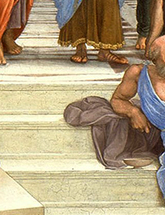 Philosophy began, on the sunny shores of the city of Miletus, as science. The first philosophers attempted to describe the processes of natural phenomena, and this has largely been the legacy of philosophy in Europe and the Arab world. But before Aristotle cast his discerning eye at the heavens and earth, began sifting and winnowing all that sensory data into categories, and cemented this scientific tone to the practice of philosophy ever after, there existed different methods.
Plato is considered to be the father of philosophy. Though only a relative handful of later philosophers had adopted his literary style of philosophical writing (Friedrich Nietzsche was one of them, prompting a modern commentator to note that Plato and Nietzsche are the only philosophers that contemporary people read for fun) he remains famous for the character of Socrates in the Platonic dialogues and the focus that he had carved out for philosophy.
Philosophy, according to Socrates, was the pursuit of discovering how to live a better life. This knowledge resides in every living person, he posited, and the method of mining this hidden treasure was knowing how to ask the right questions. Philosophy, as Socrates famously described, was not about finding the answers, but about asking the right questions.
The reason I bring this up is because this phrase, repeated so often in our culture that it has become a platitude (no pun intended), seems off to me. Today, I was thinking about some problems in my life that have gone unresolved for several years. Applying my brain – as a human being, my greatest tool – to the task of solving those problems, I have failed daily and repeatedly, though I had struck at the issues from every possible angle, seemingly asking all of the right questions.
Falling asleep in Greece
 Inside my paperback copy of One Hundred and One Famous Poems there is a yellowing bookmark. The book itself is rather plain: a Barnes & Noble publication with a faux-marbled cover and many sentimental poems, all rhyming. Nevertheless, the editor of the collection had taken great care in elevating this rather drab idea for a book into an endearing compilation of verse. He had even written his preface as a contemporary poem, meaningful line breaks and all. It ends: “It is the purpose of this little volume to enrich, ennoble, / encourage. And for man, who has learned to love / convenience, it is hardly larger than his concealing pocket.”
Maybe it was for that portable quality that I had decided to take the book with me on my three-week study abroad trip to Greece in the summer of 2006. It went halfway around the world with me and returned to the United States with a new bookmark: a receipt of purchase from an Athenian cafe. The receipt-bookmark, as I mentioned, now looks aged, and the ink has smudged deeper into the paper and lightened to a gray in the process. The top of it has creased where it protruded beyond the dimensions of the book, and on that portion is written in Greek letters the name of the establishment from which it came: *DIOGENES*.
Diogenes Cafe is located in the Plaka neighborhood of Athens, just below the base of the Acropolis, and its name strangely fit the purpose of my visits during that summer. During the trip, I lived with a group of about twenty American students from my university. When I felt like being as reclusive as the famous philosopher Diogenes (who lived in a tub in the marketplace of ancient Athens), I would walk from our hotel, then meander up the cobblestone alleys of the Plaka to the Diogenes Cafe, order a small cup of strong Greek coffee and a delicious local dessert of yogurt and honey, and read, sometimes from the small book of poetry that I had brought with me.
Reading poems in sequence, one after another, from a collection compiled by an editor is somewhat like watching a movie where every scene is acted by different characters in new settings and portraying unique storylines. Luckily the poems of this particular compilation were arranged with heart and style, so the expectations created by one author’s verse would be fulfilled by the emotions evoked in the next. The rhyming words ebbed and flowed from poem to poem like the waves of Homer’s wine-dark Mediterranean Sea, which wasn’t far away from me at the time.
On hearing the music
 A few weeks ago, after a long hiatus, I decided to play the guitar. I own a Yamaha classical, and it had been waiting many months in my family room on a cherry-wood holder. Any musical instrument one plays is refreshing to return to again, but the classical guitar is perhaps the most pleasant.
The piano, which also resides in the family room, likes to hide its vital parts and will greet you with a rasp and squeak as you slide open its wooden key cover. The alto saxophone, sharing a corner by the window of the same room with a tall leafy houseplant, must be assembled into a whole with grease to make the parts fit and water to soften up the wooden sliver of the reed. The latest member of the Family Room Ensemble is an Arabic drum, and while it is a cheerful companion, its boisterous rhythms sound almost sad without a party of dancers to accompany them.
The classical guitar, though, sits always upright on its stand, its face looking at you, ready to be played. When you pick up the guitar, you touch its gentlest part, the lacquered backside of the neck, opposite the strings, which feels like a polished marble statue, but warmer. A sweet scent wafts from the same opening in the instrument that projects its sound, like a perfume of the forest. The sound of its strings is soft and unassuming.
And yet despite its welcoming appearance, the classical guitar is a difficult instrument to play well. I had abandoned it out of frustration late last year, when after months of daily practice (not to mention the years of private lessons I took before college) I was still producing the same dull and mechanical sound from the instrument. Music is more than about getting the notes right, I told myself, it’s more than the sum of its parts.
“The Marketplace of Ideas” by Louis Menand
 Parents, friends, university professors, family members, esteemed colleagues, and new acquaintances: we are gathered here today to answer a very important question. Why did a young man who has been passionate about the study of history his whole life, who has majored in history in college, excelled in its study, and wanted nothing more than to teach and learn about the past for the rest of his life, decide not to go to graduate school?
Let me leave that question hanging in the air of the (empty) auditorium, shrug off the narcissism (it was me speaking about myself, in case anyone had hoped otherwise), and step down from the podium.
The Marketplace of Ideas: Reform and Resistance in the American University by Louis Menand tries to answer the question of how American universities (more specifically, the liberal arts departments of those schools) have become the weird places that they are. For those who pursued a liberal arts education at a large university and don’t agree that they are strange beasts, I present the following observation of Prof. Menand’s:
It takes three years to become a lawyer. It takes four years to become a doctor. But it takes from six to nine years, and sometimes longer, to be eligible to teach poetry to college students for a living. (157)
Why? Menand, in his insightful book, answers the How? by tracing the history of the modern American university from its roots in the late-nineteenth century orientation toward research, through its gargantuan growth during the Cold War with the help of government funding, through the turbulent decades of the late-twentieth century and their epistemological crises (what are we doing this for? why are we here? and what right do we have?), to the current university that we see today.
But . . . Why? Why must a student devote nine years of his life to learn to think and talk in narrow ways, and then spend the rest of his life educating the public whose instincts (for better or worse, but usually for the better) cringe at the sound and sight of this narrowness? (more…)
Turtle on the road
 On my way home from work yesterday, I ran into a turtle. Well, I didn’t hit him, I just passed him standing on the side of the road. I wouldn’t have noticed the turtle, would have thought he was perhaps a chunk of busted tire, had he not craned his head high, watchfully, scanning the cars roaring by him. Ah, that’s a turtle!
I was driving in the corporate park where I work. If I was on the highway, I would have let him take his chances – too inconvenient for me. But I knew this place, turning around would be easy, and there was parking nearby. I U-turned and drove back to help, thinking, though, that this was pretty childish of me. I don’t even pull over to help people with flat tires.
Picking up a turtle is harder that one would imagine. They run fast and on their claws, shell half an inch above the ground, like a reptilian hovercraft. He panicked when he saw me and made a dash for it. (more…)
“On the Road” by Jack Kerouac
 When I was younger, I used to love reading a good book so much that I never wanted it to end, never wanted to say goodbye to its characters. Now, in my relatively more mature years, I rarely get this feeling, though I still love to read good books. Reading the last page about Dean Moriarty, I felt little sadness.
Beat writer Jack Kerouac writes in the last pages of On the Road,
So Dean couldn’t ride uptown with us and the only thing I could do was sit in the back of the Cadillac and wave at him. The bookie at the wheel also wanted nothing to do with Dean. Dean, ragged in a motheaten overcoat he brought specially for the freezing temperatures of the East, walked off alone, and the last I saw of him he rounded the corner of Seventh Avenue, eyes on the street ahead, and bent to it again. Poor little Laura, my baby, to whom I’d told everything about Dean, began almost to cry.
“Oh, we shouldn’t let him go like this. What’ll we do?”
Old Dean’s gone, I thought, and out loud I said, “He’ll be all right.” And off we went to the sad and disinclined concert for which I had no stomach whatever and all the time I was thinking of Dean and how he got back on the train and rode over three thousand miles over that awful land and never knew why he had come anyway, except to see me.
Reading On the Road, I wondered whether the spirit of the character of Dean Moriarty had suffused itself into American culture – I saw it everywhere. The incessant traveler, lover of sights and people and smells, rubbing his belly for joy, sweating, American Odysseus without a home, Walt Whitman re-incarnate. Without Dean Moriarty, the journeys that author Jack Kerouac wrote about that he took with Dean would never have taken place. Dean was the leader. (more…)
The surrealism of war
 “Anything can happen in war”, writes Evgeni Bessonov in his memoir, Tank Rider: Into the Third Reich with the Red Army. This translation of a Russian soldier’s experiences fighting the Germans during World War II has been my recent reading staple. What does Bessonov mean when he writes that anything can happen in war?
What comes to mind for me when a veteran says something like that is something horrible about war: hand-to-hand combat, grenades blowing off limbs, losing friends in battle. But reading Bessonov’s memoir (and most other personal accounts of war) the reader encounters other stories which are equally surrealistic but not as gruesome.
Bessonov describes one instance when the Germans surprised his unit by attacking at night during a thunderstorm. His platoon retreated as they fought the enemy, but it was so dark that no soldier could tell whether the people around him were Russians or Germans. As rain poured over the forest, the darkness confused everyone and was only brilliantly interrupted by flashes of lightning, which clarified for the soldiers whether the man running next to him was a friend or an enemy. Both Russians and Germans ran through the woods in a kind of “cross country race” until they ran out of the forest and the Germans paused their assault (144-145).
In another encounter, Bessonov, who was a junior officer and only 21 years old at the time, describes getting an order from his superior officer to advance his platoon and attack the enemy. It was an altogether different day, sunny and warm, but Bessonov was exhausted from the night marches and daylight battles.
The sun started to warm us; it was quiet, one could hear only birds singing from the nearest forest, which was not yet occupied by our troops. I replied to the runner that I was about to start the attack; he left, and I again fell asleep. The runner from the company commander ran up again, with the same order and with threats from the company commander. I again replied that we would commence the attack any time soon and fell asleep again – such things had never happened to me before. The runner woke me up and again reminded me of the attack – this time, the company commander ordered him not to leave me before I started the attack. I slept under a bush on soft grass (I did not dig a trench), I had been dreaming about something peaceful and I really did not feel like dying in that quiet hour. . . I tried to think of death as little as possible, but at that moment I was merely overwhelmed by exhaustion and quietness and I really wanted to sleep. (139)
The poet Robert Frost famously likened death to sleep in his poem “Stopping by the Woods on a Snowy Evening“: “The woods are lovely, dark and deep / But I have promises to keep, / And miles to go before I sleep, / And miles to go before I sleep.” For Evgeni Bessonov in late August of 1944, the woods in front of his platoon where the enemy waited meant death. And sleep for him then was not an embrace of death, but the flight from it.
Computer games, Divine Liturgy, and imitating greatness
 I grew up in the video game generation. The public discussion about video games for the past decade, I have noticed, has been about whether violent video games encourage violent behavior in real life – parents worrying about children growing bloodthirsty. More recently, some research has attracted attention that suggests that video games may develop logical thinking and hand-eye coordination. Xbox may not be so different from chess and baseball after all. But to me and perhaps others in my generation, video games mean a bit more than that.
If I were to be brutally honest, I would have to admit that my interest in history has a bit (or a lot) to do with me playing the computer game Civilization II as a young boy. Sure, my grandpa read to me – to my great delight – when I was even younger from a children’s book about how man made fire by rubbing sticks and crafted the first primitive tools. But that did not capture my imagination as much as building an empire while playing as the ancient Egyptians in Civilization II or amassing an armada of ships that terrorized the high seas while commanding the Spanish. I piloted an aircraft in the game Aces Over Europe (like my granpda, who flew in real planes in World War II) and won glory for my country as a skilled warrior. I was a hero, like my forebearers. Or, I practiced to become one.
Games are more than about shooting people and destroying things. They are even more than about cognitive and reflexive development. For a child, especially in America where communities lack other rituals for developing self-identity, such games allow you to imitate the greatness of your ancestors. In Plato’s terms, by imitating great deeds (such as defending one’s country as a fighter pilot in World War II) a child may take part in the Forms of Courage, Duty, and Camaraderie. In such a way, he fosters a sense of belonging and duty to his community.
Playing computer games, seen from this perspective, is not much different than taking part in the Divine Liturgy in church. The Liturgy is a play similar to ancient Greek drama: the congregation, an adaptation of the Greek chorus, re-enacts the story of Christ every Sunday and takes part as participants on the stage. After all, is not theater just a type of game, where the actors and audience suspend their sense of disbelief at their imitation of reality just as gamers do? For the sake of something greater, every person is willing to suspend their sense of disbelief.
These are just some cursory and perhaps simplistic observations. I thought I may post this because I have been thinking that this pull towards imitating greatness – either through games or theater or rituals – remains with people (or at least has with me) even into adulthood. I read about the Battle of Britain and I still want to strap into a virtual cockpit. I watch an episode of The Pacific on HBO and I feel the urge to play Call of Duty: World at War. I feel the lack of adventure in my life, and I play The Lost Files of Sherlock Holmes: The Case of the Serrated Scalpel. Or I read literature, for it too is an escape (or transcendence) of reality.
We all played games when we were children, but we also all persist in other forms of imitation as adults. Why? And to what end? Maybe if we can answer these questions, we could clear up a lot of others about the purpose in contemporary life of religion, art, and – not to forget – even video games.
 HistoryJournal.org
3 comments