That constitution is best which…
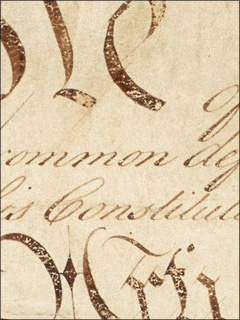 An upcoming study in the New York University Law Review finds that the U.S. Constitution is losing favor as a model for new constitutions around the world, reports the New York Times. Since the 1960s and 1970s, when the American document witnessed its height of popularity, foreign governments have turned to more progressive constitutions such as the Canadian Charter of Rights and Freedoms for inspiration.
The N.Y. Times article suggests three reasons for the decline in popularity worldwide of our Constitution: (1) America’s decreasing influence and reputation, (2) conservative judges’ insistence that the original intent of the Founding Fathers be considered in rulings, and (3) the absence of rights that are featured in other nations’ constitutions (e.g. rights to travel, food, education, and healthcare).
Should these be causes for concern for Americans?
Addressing the first reason, I think the greatest blows to American reputation happen when the U.S. initiates wars of questionable cause. American involvement in Vietnam and Iraq (2003-2011) soured America’s image around the world during a time when we needed support for broader conflicts (Cold War and the War on Terror, respectively). We should become more wary of beginning a war. (more…)
What have we learned from the Iraq War?
The news stories are sounding awfully familiar. Nuclear weapons inspectors return home from the Middle East frustrated by their uncooperative hosts. The U.S. threatens military action. Television and radio channels across the world beat the battle drums. Public opinion rises in favor of war.
It seems like the prelude to the Iraq War is now repeating itself with Iran. The bulk of American armies quartered in Iraq flew back home in December. They were met in the United States quietly and with respect for their hard-fought victories. But the nation also remained silent about what the Iraq War has meant for the future of American foreign and domestic policy. There has been no real dialogue about this, and that is worrisome.

Source: NBC News/WSJ Polls via PollingReport.com
America buried thousands of its soldiers in the Middle East, and Iraq lost hundreds of thousands of soldiers and civilians because of the conflict. The Iraq War cost the American taxpayer nearly 2 trillion dollars. This money could have been used to help solve the healthcare problems in America or even just eliminate our chronic budget deficits.
But the public seems willing to sacrifice more blood and treasure in Iran without even discussing the cost. Saddled by a monstrous amount of debt, can our nation even afford another such war?
The president, who may have to take a hard line against Iran as a diplomatic tactic, can’t initiate a national dialogue about the feasibility of war in Iran. That’s the job of Congress, the media, and the public–before the decision is made for us. And the war in Iraq is an excellent reference point for such a debate.
New history books (January 2012 edition)

Below is a survey of books that were published in the past month or so and look to me like interesting reads (note: I have not actually read these books yet, and these are previews not reviews).
…
War of 1812
 This year marks the 200th anniversary of the War of 1812. Many overlook this conflict, but it inaugurated important changes for America. During the war, America tried unsuccessfully to invade Canada, Washington D.C. was invaded and burned by the British, American Indian unification efforts (which were supported by the British) against the colonists were dealt a punishing blow, and the lyrics of the “Star Spangled Banner” were composed. After the war, British and American relations began to improve until eventually the two nations became each other’s closest ally in the 20th Century.
Several new books are being published in commemoration of the anniversary. Three that were released last year—two popular ones by George C. Daughan and Stephen Budiansky and a more scholarly one by Kevin D. McCranie—focus on the naval conflict. But the best new overview of the War of 1812 is by J.C.A. Stagg and is due to come out on March 31 of this year.
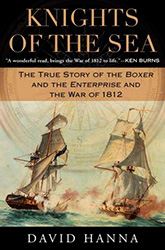
The book I’m most excited to read, though, is David Hanna’s Knights of the Sea: The True Story of the Boxer and the Enterprise and the War of 1812. The ships HMS Boxer and USS Enterprise dueled off the coast of Maine on a brisk autumn day. The captains of the opposing vessels were later buried together in a dual funeral on the American shore, inspiring the poem “My Lost Youth” by Henry Wadsworth Longfellow. (more…)
Memoirs of a Russian submariner
 In high school English class, I was taught about the three general types of conflict that one may encounter in literature: Man vs. Nature, Man vs. Man, and Man vs. Self. Memoirs from combatants of the Second World War are often as exciting to read as literature because all three types of conflict figure into them on a grand scale. But there is a fourth type of conflict that we didn’t learn about in class but which, particularly for the men and women of the Soviet armed forces, added that extra dimension of drama: Man vs. Machine.
The nation that brought the world Lada and Zhiguli cars–which asked of their owners to spend nearly every weekend under their jacked-up chassis salving their ever-irritated metal bowels–produced submarines during WWII that would never quite pass muster in an American or German shipyard. This run-down state of submersible machinery can be fully appreciated by reading Victor Korzh’s memoir, Red Star Under the Baltic: A Soviet Submariner in WWII.
As the chief engineer aboard these subs, Korzh knew every nut and bolt and describes their mechanical failures with the technical detail befitting a master. But the inability of Soviet designers and shipyards to perfect submarine design is no stain on the reputation of the Russian sailor. On the contrary, the Russian submariners’ ability to not only survive but also sink many German merchantmen in the unforgiving seas of the Baltic is a testament to their boldness and technical ingenuity. (more…)
Manhattan first impressions
 FAIRWAY MARKET on the Upper West Side is like an open-air market trapped under a roof. Located on a busy commercial street, the entrance to the store is flanked by open fruit and vegetable stands over a large faded awning which reminded me of street vendors in Thailand.
Inside, there is a scramble of activity. A general checkout line stretches from the cashier stands far back into the dairy products aisle. Lines are everywhere—to the seafood stand, the deli, the aisle with the cooking oils—but they are all rapidly moving forward.
Men in suits coming back from work squeeze through the narrow space between shelves to get around other shoppers: young women with strollers, older ladies in puffy black coats with fur collars, hipsters sampling different flavors of olive oil, a gray-browed man pounding an air piano with one hand as he listens to an iPod.
Two employees hidden in a nook are busy servicing a separate line of customers wanting to get coffee. They take orders, scoop pungent black beans from barrels, sprinkle them into grinding machines, pack the resulting powder into paper packets, and give it to the customers. The nook is heavy with the sweaty scent of crushed beans. Ahead of them is an even larger nook whose three walls are resplendent with fine cheeses.
Two men—one on a ladder—empty a wooden cart onto an unreachably tall pyramid of oranges. It has a sculpted shape formed by perfect layers—like bricks—of fruit, but I notice that the men aren’t forming the newly-plumped oranges into the pyramid themselves. Does this mass of fruit just take on its own shape? (more…)
Love of art in the Siege of Leningrad

This first of a series of posts, called “In the Abstract”, are ideas for topics for new history books. Sometimes historians, I think, shoot themselves in the foot by framing their research projects in an uninteresting way. Others, though, do this masterfully and create history books that are engaging, relevant, insightful, and bring the characters and world of another age to life not only for the academic community but for the general public too. Often the path of success or failure begins in the choice of topic. In an effort to sharpen my skills in framing historical topics, I welcome your criticism and comments of my imaginary abstract.
…
ART is frequently seen as flourish to life for those that can afford leisurely activities. Love of art is something that supposedly dies in people when other, more basic, human needs are not being met. But to a select group of Russian writers, poets, artists, and musicians that lived in Leningrad during the siege of 1941-44 by the German army, the drive to produce new creative work did not vanish. Amid the base struggle for survival in that city under blockade, with starvation, violence, death, cannibalism, terror, and inhumanity permeating their existence, many artists in Leningrad later wrote that they experienced the strongest artistic drive of their lives. There has not been a book in English devoted to their stories. A book about the individuals, meeting places, and creative works that these artists produced (among them Dmitri Shostakovich’s Symphony No. 7–the “Leningrad Symphony”) under the most unpromising circumstances would be a testament to the basic importance of creativity in human life.
History off the press (December ’11 edition)

Below is a survey of books that were published in the past month or so and look to me like interesting reads (note: I have not actually read these books, and these are previews not reviews).
…
Africa
 I’m currently reading William L. Shirer’s The Rise and Fall of the Third Reich, and one of among many striking things about Nazi Germany is how easily a multitude of religious leaders in that country kowtowed to Hitler’s religious decrees (which needless to say were staggering in their impiety—replacing the Bible in pulpits with Mein Kampf, for instance). Religions like Christianity derive their power from writing and oratory. But if those mesmerizing words are not backed by deeds when the going gets rough (i.e. when the Gestapo will kill you if you continue practicing authentic Christianity) then such sermonizing appears in hindsight like idle chatter.
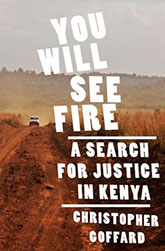
That’s why I can’t help but admire a guy like Sam Childers. After he converted to Christianity, he traded a life of drugs, motorcycle gangs, and chasing women in America to become a machine-gun armed protector of orphans and other destitute children in violence-ravaged Sudan. That’s some tough, in-your-face Christianity and not of the “Have you heard the Good Word? Here, take a pamphlet” variety. Childers has published a memoir of his experiences. (more…)
“Song of a Fighter Pilot”
 Vladimir Vysotsky wrote such evocative songs about World War II that it’s impossible to tell that he himself didn’t serve in that conflict. His verse on the theme of friendship is especially amazing.
Because of songs like his and the Russian culture of my upbringing, the symbolism of World War II (or, as the Russians call it, The Great Patriotic War) has stayed with me as a kind of arch-metaphor for the human condition.
I was listening today to one of my favorite songs by Vysotsky called Pesnya lyotchika-istrebitelya: “Song of a Fighter Pilot”. It is one of the greatest poems about friendship that I have ever read, and I decided to translate it into English. My translations skills are limited, but though my version inevitably may have errors, I have done my best to convey both the meaning and the flow of the song. The original, like most Russian poems and songs, has a rhyme scheme.
The song is about two Russian fighter pilots in World War II that find themselves embroiled in a losing battle with a larger German fighter formation. You can listen to the original song on YouTube and read the lyrics in Russian here.
…
Song of a Fighter Pilot
By Vladimir Vysotsky
(Translated by Alex L.)
Eight of them and two of us. Our prospects before battle
Aren’t bright, but we’ve committed to the fight.
Seryozha!* Hold on, it’s looking dim,
But we we have to get an edge in the game. (more…)
Canada and the recession

My lovely girlfriend, a Canadian citizen, challenged me to write something about the more northerly part of North America. Since I’ve also wanted to write a post dealing with economics, badabing badaboom: here’s an article about the Canadian economy. I’m not a professional economist but this entry (and future ones like it) are my way of engaging with economic facts and data on my own so I don’t have to rely solely on the opinions of commentators. That’s why I’m counting these entries as part of my “Economics Sandbox”. Please feel free to correct, comment, question, and enlighten.
I was recently surprised to read that Canada was weathering the economic downturn much better than the United States. What does that mean exactly? I looked at some data to get a better idea.
Just looking at GDP growth, it looks like Canada’s economic output was affected in almost exactly the same way as the U.S. economy.

Source: World Bank
But GDP growth is not the only (or even the best) measure of a country’s economic health.When I looked at unemployment rates, it’s clear that America’s labor market has been in worse straits than Canada’s since the recession started in 2008. (more…)
History off the press (October ’11 edition)

Swords to plowshares
President Obama recently announced that the United States will recall all of its armed forces personnel from Iraq by the end of 2011. This is a strange outcome for those of us who remember the seemingly insurmountable setbacks created by the insurgency before the 2007 surge of American troops unraveled the extremists’ grip on the country. It was hard to see back then that the situation in Iraq could improve. But it did. The following books explore in a unique way the nature of organized violence in the contemporary world.
…
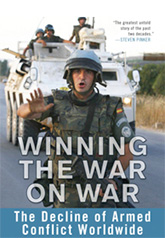 Although we may not realize it from all of the news dispatches dripping with depressing forebodings of disaster either due to economic or glacial meltdown, there are reasons to be optimistic about the current state of the world. Joshua S. Goldstein, in a new book called Winning the War on War: The Decline of Armed Conflict Worldwide, makes the case that the human race is freer from war now than it has ever been. The facts tell a counterintuitive but inspiring story: there are currently no nations at war in the world (only civil wars are going on) and last year had one of the lowest death rates from armed conflict in history.
Along similar lines, Steven Pinker has just published a similar work. Pinker makes the same observation – “we may be living in the most peaceful time in our species’s existence” – but approaches the subject from the perspective of psychology, his field of study, rather than international affairs. Both of these perspectives are worth keeping in mind the next time you hear a pundit on cable news or a sensationalistic author prophesying apocalypse for Western civilization just to get your attention. (more…)
 HistoryJournal.org
2 comments