“The Hunley” movie
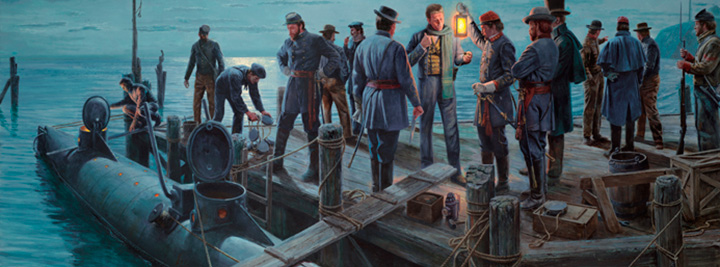
Having moved back from New York City, I discovered that my familiar public library in northwest Chicagoland got a facelift. The wall between the children and adult sections has been torn down, creating a pleasant sense of open space. While browsing there last week, I chanced upon a movie I had never heard about before: “The Hunley.”
A TNT movie from 1999, it didn’t win any awards for acting (though it did win an Emmy for sound editing). I enjoyed watching “The Hunley” because it recreates what it may have been like to serve aboard the first effective combat submarine in history. Starring Armand Assante, it has a bit of an action movie feel to it. For a film taking place inside of a weapons platform propelled by the underwhelming power of half a dozen men cranking away at the propeller shaft by hand, the high-intensity aesthetic is a bit of a mismatch. (more…)
Biographies of Paul the Apostle
 A few days ago, I started reading a book that I bought about a year ago in a bookstore’s bargain aisle. The book is Paul by E.P. Sanders from the “A Brief Insight” series. The letters of the Apostle Paul form a big chunk of the New Testament. In those letters, his unique way of addressing problems in religious communities have had an enormous influence on the development of Christianity.
But Sanders’s 200-page work is the first book I’ve ever read focused specifically on Paul. Before I even finished reading the first chapter, I already started thinking about what the next book would be that I would read about Paul. I do this often: whenever I get interested in a new topic, I go on Amazon.com and try to find the most authoritative book on that subject. It’s handy information. Sometimes I even make a short bibliography of what the first books would be that I would read if I were to study the topic more closely.
It’s always satisfying to find the one definitive book on a subject: a recently-published and comprehensive resource you can turn to that will bring you up to speed on a subject in one fell swoop. Interested in Johannes Brahms? A quick search on Amazon.com will reveal that Jan Swafford’s biography, a 752-page tome decorated with 33 reviews averaging 4.5/5 stars, is beyond a shadow of a doubt the place to turn for all your Brahms needs. (more…)
Aircraft and submarine restoration near Chicago

I really like the kind of reality shows where you get to watch experts performing complex jobs with great skill. I enjoy it all: from Ice Pilots NWT, where aviators brave extreme winter conditions to fly in northern Canada, to Big Shrimpin’, a show about fishermen plying their trade off of the southern coast of the United States.
These past couple of weeks I’ve been interested in a show called Tank Overhaul. Each episode features a crew of a few men restoring rusty and battle-damaged tanks (from the World War II era and later) to like-new condition. There’s just something about sand-blasting decades-old rust from a tank chassis to reveal a brilliant metallic surface underneath that gets me going. With a wave of a wand (literally) time is reversed and these half-decayed battle tanks come to life again.
Truth be told, though, I’m not a big tank enthusiast. But this show got me thinking about the restoration and preservation of two types of machines that I do have a passion for: (no surprise here to anyone who reads this blog) submarines and airplanes. So I got to imagining: is there anywhere in the Chicago area where I can see or even volunteer in the restoration of these historical artifacts?
A simple search revealed a few interesting leads. (more…)
Plans for 2013
I’ve been mulling over two new ideas for 2013. First, I want to try posting more informal articles charting my day-to-day thoughts about history and the material I read about. I often put in a lot of time into preparing each blog post and have strayed from my original intention of making this blog more of a semi-daily journal of intellectual impressions. I still hope to keep the quality of writing and ideas as high as I can, and hopefully this more casual style will even help with that.
On to the second idea. It’s difficult for me to keep up a habit of research outside an academic community like a university. Nevertheless, I miss the challenge of sustaining a focused examination of a single topic like when I wrote my senior thesis in college. At first, I considered the idea of creating a history-themed website like uboat.net or The Aerodrome. I then thought that sites such as those are like a topic-specific data warehouse. I am more interested in telling the stories of the past through narratives rather than catalogs of data. But I also realize that conducting original research in the military history topics that I’m interested in would take up more time than I would like. So currently I’m toying with the idea of making a history podcast along the lines of the History of Rome Podcast or the History of WWII Podcast. The level of detail in these podcasts — in especially the latter example — gives listeners a sense of immersion in the time period and events being discussed. Making a podcast would encourage me to do a good amount of research about a single subject without the need for a comprehensive mastery of the sources. I’ve already started doing background reading on my first topic of interest: U.S. submarine operations against Japan, 1941-1945. I’ll write more about what I’ve read so far and what I will read in the future.
The next post will be about the new history books for January. I’ll also be reviewing Adam Makos’s A Higher Call, which I just finished reading. Will write again soon!
New history books (August-December 2012 edition)

Below are new books published in the second half of 2012 that seemed to me like really interesting reads in my favorite fields (ancient philosophy and military history). This is a condensed version of my typical monthly books post, but I hope to return to my usual reviews and previews again next month.
…
December
Churchill and Seapower. Christopher M. Bell. Churchill was a leading naval strategist in both the First and Second World War. This is the first systematic study of his role in naval affairs and should be an informative read.
Aviation (rarities)
A Higher Call: An Incredible True Story of Combat and Chivalry in the War-Torn Skies of World War II by Adam Makos and Larry Alexander
Operation KE: The Cactus Air Force and the Japanese Withdrawal from Guadalcanal by Roger Letourneau and Dennis Letourneau
The North African Air Campaign: U.S. Army Air Forces from El Alamein to Salerno by Christopher M. Rein
Viper Pilot: A Memoir of Air Combat by Dan Hampton
Blue Moon over Cuba: Aerial Reconnaissance during the Cuban Missile Crisis by William B. Ecker and Kenneth V. Jack
Notable mentions
Ships of Oak, Guns of Iron: The War of 1812 and the Forging of the American Navy by Ronald Utt
Demosthenes of Athens and the Fall of Classical Greece by Ian Worthington
The First Thousand Years: A Global History of Christianity by Robert Louis Wilken
… (more…)
New history articles (August-December 2012 edition)
Since I’ve fallen behind on my monthly articles and books posts, I’ve decided to condense the past several months into a couple final posts for the year. That way, I can start 2013 afresh with the regular format, reviewing and previewing books and articles every month. Below are the articles for the second half of 2012 that interested me but that I haven’t had a chance to review on this blog.
…
December
“Vernacular Metaphysics: On Terrence Malick’s The Thin Red Line“ by Robert Pippin in Critical Inquiry (Winter 2013).
“How Motion Pictures Industrialized Entertainment” by Gerben Bakker in The Journal of Economic History (December 2012).
“Ethical Progress as Problem-Resolving” by Amanda Roth in The Journal of Political Philosophy (December 2012).
…
November
“Intuiting Gods: Creed and Cognition in the Fourth Century” by Marilyn Dunn in Historical Reflections (Winter 2012).
“Imagining the Unconscious” by Wouter J. Hanegraaffa in Intellectual History Review (Winter 2012).
“Overshadowed New York” by Cyrus R. K. Patell and Bryan Waterman in American Literary History (Winter 2012).
… (more…)
New history articles (July 2012 edition)

“Virtually a Historian: Blogs and the Recent History of Dispossessed Academic Labor” by Claire Bond Potter in Historical Reflections (Summer 2012).
Like the recording and newspaper industries, humanities departments in universities have struggled to generate enough income for their practitioners in the Information Age. Many members of this “dispossessed academic labor” pool vent their frustrations with the system online on blogs. Potter sees these (often anonymous) online criticisms as one of the only honest records available of how unemployed and underemployed historians truly feel about the labor conditions in higher education.
As someone on the brink of entering the profession of history, I find myself somewhat repulsed by the stygian tone of the more vociferous academic blogs. Part of me blames these down-and-out historians for not being more creative in how they practice history: is trudging the academic career path that they profess to hate really the only option they see for themselves? Why not reach out to the public, which finds history intrinsically interesting and presents a larger market for writing than the academy?
But the more empathetic part of me understands that such a recommendation is glib and naive. It is not so wise to abandon the academy completely as to reform it. And that won’t come without an honest — and often unpleasant — voicing of dissatisfaction with the current state of things. (more…)
‘Low work’ over the Western Front
 Comedian Jerry Seinfeld once said that the mark of a great joke is that it stays with you long after the first hearing. There’s something about its premise or symbolism that makes you see the world — or some small part of the world — differently. A great poem functions in a similar way, wrote Poet Laureate Ted Kooser. I also feel this way about Victor Maslin Yeates’s autobiographical novel, Winged Victory. I will never think of aerial warfare during the First World War in the same way after having read this book.
It’s not just that Yeates describes the historical moment well. Tom Cundall’s, the protagonist, two flight commanders (Captains Beal and MacAndrews) seem to me like literary recreations of two of the Royal Flying Corps’s legendary aces. Their names even sound similar to the real historical figures. Captain Beal seems to represent Albert Ball, one of the RFC’s earliest heros. Like Ball, Beal is seemingly fearless in accomplishing his gruesome work. Thousands of machine gun bullets fired in his general direction don’t seem to faze him: he is a rare specimen in war. Both the historical and literary figure die in the war, unable to beat the odds against such reckless courage for too long.
The character of MacAndrews (“Mac”) seems to represent the British ace and winner of the Victoria Cross, James McCudden. After Albert Ball’s death, McCudden became one of the leading stars of the RFC. His tactics differed vastly from Ball’s lone-wolf gallantry. McCudden developed the principles of aircraft working in concert with one another to press their advantage against an enemy air formation. If the advantages were not there, McCudden would have no qualms with fleeing the field of battle to fight another day. Through these characters, Yeates gives us an insider’s view into the real-life heroes of the Royal Flying Corps. (more…)
New history books (July 2012 edition)
Scholarship of an empire
 There are really two narratives of the Roman empire. The first one picks up where the Iliad ends, follows the story of Aeneas until the time of the early kings of Rome, observes with admiration the Roman republic, and illustrates the glories and flaws of the Roman emperors. This is the traditional story of ancient Rome.
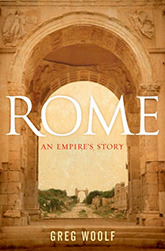
The second type of narrative is the academic one, which often leaves chronology by the wayside and examines the Roman empire by topic, often sociologically. Greg Woolf’s new book, Rome: An Empire’s Story, seems to be written for the niche of people who are well familiar with the first, traditional, narrative of Rome but have no knowledge of (but a desire to learn) the second, scholarly, dialogue about the empire.
Although Woolf’s writing didn’t inspire an enormous amount of enthusiasm from this reader, the most interesting chapter for me was the second one: “Empires of the Mind.” Reading this chapter made me wonder why it was that Rome apart from all other ancient empires has such a lasting existence in our world. Woolf here also discusses sociological categorization of empires and describes Rome as a conquest state, an entity dependent on political expansion for its very survival. I think such a breakdown of terms like “empire” is useful because, without further reflection, one may assume erroneously that the Roman empire was more similar to, say, the American empire than was actually the case. The United States may arguably be an imperial power but it is not a conquest state. (more…)
New history articles (June 2012 edition)
With this post, I’m starting a new monthly article series called “Historical Proceedings” that reviews a sampling of the new historical articles published in mostly academic journals (but also some popular magazines). I’m a few months behind on these and also on my monthly posts about new history books, but I’m working to catch up.
As with the books, I’ll be choosing articles every month that I think are interesting, enlightening, and well written (all, admittedly, subjective criteria). I hope these posts inspire you to read new works of history and to share your comments with me below.
…
 “The Repression of Soviet Koreans during the 1930s” by Alexander Kim in The Historian (Summer 2012).
Joseph Stalin killed so many people from so many different communities during his purges of the 1930s that it’s hard to deny the veracity of the quote that is often attributed to him: “a single death is a tragedy; a million deaths is a statistic.” To understand the human toll of the purges, it helps to take a closer look at one cross-section of the population that was affected by them.
Alexander Kim writes in The Historian, a publication of the Phi Alpha Theta Historical Honor Society, about Soviet Koreans who were forcibly relocated from their homes in the Far East to barren lands in Kazakhstan. That they were accused of trumped-up charges of spying for the enemies of the Soviet Union was not unique by Soviet standards of the 1930s. But Kim describes how the Soviet Koreans’ integrality to the local economy (they were adept vegetable farmers) and easy ability to escape Soviet authorities by crossing the border into China delayed their repression by Stalin’s agents. That was something most other groups were not able to do during the purges. (more…)
 HistoryJournal.org
2 comments