Mattie and Achilles
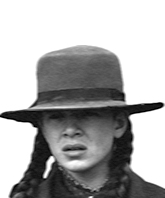 I hadn’t heard of the new movie “True Grit” until my friend Mike called me up to go to the theater a few days ago. Because I was vehemently uninterested in seeing “Tron”, the Coen brothers’ new movie seemed like a good alternative after glimpsing descriptions of shows playing in local theaters.
I saw “True Grit” that evening, and I can’t wait to watch it again while it’s playing on the big screen. The movie was fantastic. I hadn’t heard of the original “True Grit” with John Wayne, nor had I read the novel by Charles Portis on which both movies were based, but I think I appreciated the movie more for having known nothing about it beforehand. If you haven’t seen “True Grit” in theaters yet, I recommend you don’t read the rest of this article.
Stanley Fish of the New York Times has a high-quality article about the religious undertones that he perceives throughout the new “True Grit”. His point is that this movie avoids creating a two-dimensional picture of reality. This is what makes it different from (and perhaps better than) the John Wayne version. Protagonists suffer alongside antagonists, and all display traditional heroic qualities. Reward and punishment for any kind of virtue or immorality, respectively, is not meted out in the way everyone expects; if you have lived virtuously, it is no guarantee that something unspeakably horrible won’t befall you in this world.
And yet “True Grit” is different from the Coen brothers’ earlier Western-style film, “No Country for Old Men”. That film was thoroughly depressing. Evil, in the form of the cattle-gun wielding character of Anton, stalks every good person, eventually destroys them all, and leaves nothing redeeming in its wake. “True Grit” has brighter moments.
Building aircraft out of ash wood and Irish linen

If left to my own devices, without the influence of classes or teachers or scholarly communities, my interests will naturally gravitate and oscillate between two subjects: submarines and airplanes. It has been like this since I was in middle school, except now instead of scouring books for colorful pictures and playing computer simulations, I read memoirs and secondary sources about air wars and naval battles of the 20th century.
After a visitation from the Muse of U.S. Submarine Operations in the Second World War (which compelled me to dive deep into my long-shelved copy of Clay Blair’s classic, Silent Victory: The U.S. Submarine War Against Japan) my tastes were swung upwards and backwards to the heights of the air war during World War I. What did it this time was a documentary I watched on YouTube one night about the British aces James McCudden and Edward Mannock, which described their struggles with the stresses of primitive air combat and their untimely deaths.
This led me to embark on an unsystematic perambulation through the history of air combat during World War I. Curse Amazon and their “1-Click Ordering”, but I impulsively bought James McCudden’s memoir, Flying Fury: Five Years in the Royal Flying Corps, for my Kindle and received instant gratification reading it at a local Starbucks. I am still working through it, but have also gone on to watch other documentaries freely accessed on YouTube on the subject (such as this hidden gem: “Aces: A Story of the First Air War”, the probably-fictional story of a Canadian pilot in the RFC as narrated to his grandson).
As part of this binge of media consumption, I stumbled upon (though not through StumbleUpon, which I tried as a novel way to browse the web but with which I was slightly disappointed) a site called The Vintage Aviator, which is the actual topic of this post. (more…)
I’m posting every week in 2011!
 I read about WordPress’s PostAWeek Challenge for 2011 today, and it made me think about how I have more articles sitting in my “Drafts” folder from the past six months than those that have actually been published. I think I have been leaning too heavily on the side of “literary-like” writing lately (and hence killing drafts with an overly-zealous editing standard) and less on the more informal style which is the hallmark of blogging.
So, at the risk of this blog degenerating into a collection of YouTube videos about my hauls, I will publish an article every week on this blog in 2011. The sample post suggested by WordPress, with such phrases as “[relying on] the community of other bloggers” and “asking for help when I need it” makes this challenge sound almost like a substance-abused support group. I guess one can “abuse” the instinct to edit to the point of crippling the writing process altogether. I’ve also been coming around to the realization that online communities are a legitimate way to connect with people (strangely enough, an article titled “Why I Hate Social Media” and its related commentary sparked this realization – perhaps more on this later), so WordPress may have a point there.
Since one of the reasons for this blog has been to train myself to write better (hence the push-ups image, in case you were wondering) and since that can’t be accomplished without me actually writing once in a while, look for at least a post a week on this blog in 2011 (I’m thinking Sundays).
The perils of manipulation
 A Mosque in Munich: Nazis, the CIA, and the Rise of the Muslim Brotherhood in the West
by Ian Johnson.
Houghton Mifflin Harcourt, 318 pp., $27 (or free at your local library).

Most people in the United States know that the CIA supported and equipped the mujahideen to fight against the Soviets in Afghanistan during the 1980s. This, and the dangers of such a strategy, are now common knowledge. What most Americans don’t know and what journalist Ian Johnson has investigated and described in his book, A Mosque in Munich, for the first time, is that the US strategy of using Islam as a tool of foreign policy has an even longer history that stretches back to events surrounding the Second World War.
This story is one of harsh realpolitik with many covert operations conducted by the US, West Germany, and the Muslim Brotherhood that centered around a mosque in Munich during the Cold War. There are few relatable characters in Johnson’s book, but several of them led colorful lives of travel and geopolitical intrigue as they struggled to co-opt the religion of Islam for national or ideological purposes.
Kaiser Wilhelm II was perhaps the first modern European leader to engage in this kind of manipulation with the goal of undermining another Western power, England, in the diplomatic wrangling leading up to World War I (a book devoted to this topic, The Berlin-Baghdad Express: The Ottoman Empire and Germany’s Bid for World Power by Sean McMeekin, was published in September).
The Germans picked up on this idea during World War II, when they realized that many Muslims living in the Soviet Union were embittered citizens and could be convinced to fight in Nazi uniform against the Soviets when they were captured. About 150,000 Soviet Muslim prisoners volunteered for service in the German army during World War II.
On asking the right questions
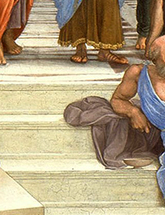 Philosophy began, on the sunny shores of the city of Miletus, as science. The first philosophers attempted to describe the processes of natural phenomena, and this has largely been the legacy of philosophy in Europe and the Arab world. But before Aristotle cast his discerning eye at the heavens and earth, began sifting and winnowing all that sensory data into categories, and cemented this scientific tone to the practice of philosophy ever after, there existed different methods.
Plato is considered to be the father of philosophy. Though only a relative handful of later philosophers had adopted his literary style of philosophical writing (Friedrich Nietzsche was one of them, prompting a modern commentator to note that Plato and Nietzsche are the only philosophers that contemporary people read for fun) he remains famous for the character of Socrates in the Platonic dialogues and the focus that he had carved out for philosophy.
Philosophy, according to Socrates, was the pursuit of discovering how to live a better life. This knowledge resides in every living person, he posited, and the method of mining this hidden treasure was knowing how to ask the right questions. Philosophy, as Socrates famously described, was not about finding the answers, but about asking the right questions.
The reason I bring this up is because this phrase, repeated so often in our culture that it has become a platitude (no pun intended), seems off to me. Today, I was thinking about some problems in my life that have gone unresolved for several years. Applying my brain – as a human being, my greatest tool – to the task of solving those problems, I have failed daily and repeatedly, though I had struck at the issues from every possible angle, seemingly asking all of the right questions.
Falling asleep in Greece
 Inside my paperback copy of One Hundred and One Famous Poems there is a yellowing bookmark. The book itself is rather plain: a Barnes & Noble publication with a faux-marbled cover and many sentimental poems, all rhyming. Nevertheless, the editor of the collection had taken great care in elevating this rather drab idea for a book into an endearing compilation of verse. He had even written his preface as a contemporary poem, meaningful line breaks and all. It ends: “It is the purpose of this little volume to enrich, ennoble, / encourage. And for man, who has learned to love / convenience, it is hardly larger than his concealing pocket.”
Maybe it was for that portable quality that I had decided to take the book with me on my three-week study abroad trip to Greece in the summer of 2006. It went halfway around the world with me and returned to the United States with a new bookmark: a receipt of purchase from an Athenian cafe. The receipt-bookmark, as I mentioned, now looks aged, and the ink has smudged deeper into the paper and lightened to a gray in the process. The top of it has creased where it protruded beyond the dimensions of the book, and on that portion is written in Greek letters the name of the establishment from which it came: *DIOGENES*.
Diogenes Cafe is located in the Plaka neighborhood of Athens, just below the base of the Acropolis, and its name strangely fit the purpose of my visits during that summer. During the trip, I lived with a group of about twenty American students from my university. When I felt like being as reclusive as the famous philosopher Diogenes (who lived in a tub in the marketplace of ancient Athens), I would walk from our hotel, then meander up the cobblestone alleys of the Plaka to the Diogenes Cafe, order a small cup of strong Greek coffee and a delicious local dessert of yogurt and honey, and read, sometimes from the small book of poetry that I had brought with me.
Reading poems in sequence, one after another, from a collection compiled by an editor is somewhat like watching a movie where every scene is acted by different characters in new settings and portraying unique storylines. Luckily the poems of this particular compilation were arranged with heart and style, so the expectations created by one author’s verse would be fulfilled by the emotions evoked in the next. The rhyming words ebbed and flowed from poem to poem like the waves of Homer’s wine-dark Mediterranean Sea, which wasn’t far away from me at the time.
On hearing the music
 A few weeks ago, after a long hiatus, I decided to play the guitar. I own a Yamaha classical, and it had been waiting many months in my family room on a cherry-wood holder. Any musical instrument one plays is refreshing to return to again, but the classical guitar is perhaps the most pleasant.
The piano, which also resides in the family room, likes to hide its vital parts and will greet you with a rasp and squeak as you slide open its wooden key cover. The alto saxophone, sharing a corner by the window of the same room with a tall leafy houseplant, must be assembled into a whole with grease to make the parts fit and water to soften up the wooden sliver of the reed. The latest member of the Family Room Ensemble is an Arabic drum, and while it is a cheerful companion, its boisterous rhythms sound almost sad without a party of dancers to accompany them.
The classical guitar, though, sits always upright on its stand, its face looking at you, ready to be played. When you pick up the guitar, you touch its gentlest part, the lacquered backside of the neck, opposite the strings, which feels like a polished marble statue, but warmer. A sweet scent wafts from the same opening in the instrument that projects its sound, like a perfume of the forest. The sound of its strings is soft and unassuming.
And yet despite its welcoming appearance, the classical guitar is a difficult instrument to play well. I had abandoned it out of frustration late last year, when after months of daily practice (not to mention the years of private lessons I took before college) I was still producing the same dull and mechanical sound from the instrument. Music is more than about getting the notes right, I told myself, it’s more than the sum of its parts.
“The Marketplace of Ideas” by Louis Menand
 Parents, friends, university professors, family members, esteemed colleagues, and new acquaintances: we are gathered here today to answer a very important question. Why did a young man who has been passionate about the study of history his whole life, who has majored in history in college, excelled in its study, and wanted nothing more than to teach and learn about the past for the rest of his life, decide not to go to graduate school?
Let me leave that question hanging in the air of the (empty) auditorium, shrug off the narcissism (it was me speaking about myself, in case anyone had hoped otherwise), and step down from the podium.
The Marketplace of Ideas: Reform and Resistance in the American University by Louis Menand tries to answer the question of how American universities (more specifically, the liberal arts departments of those schools) have become the weird places that they are. For those who pursued a liberal arts education at a large university and don’t agree that they are strange beasts, I present the following observation of Prof. Menand’s:
It takes three years to become a lawyer. It takes four years to become a doctor. But it takes from six to nine years, and sometimes longer, to be eligible to teach poetry to college students for a living. (157)
Why? Menand, in his insightful book, answers the How? by tracing the history of the modern American university from its roots in the late-nineteenth century orientation toward research, through its gargantuan growth during the Cold War with the help of government funding, through the turbulent decades of the late-twentieth century and their epistemological crises (what are we doing this for? why are we here? and what right do we have?), to the current university that we see today.
But . . . Why? Why must a student devote nine years of his life to learn to think and talk in narrow ways, and then spend the rest of his life educating the public whose instincts (for better or worse, but usually for the better) cringe at the sound and sight of this narrowness? (more…)
Turtle on the road
 On my way home from work yesterday, I ran into a turtle. Well, I didn’t hit him, I just passed him standing on the side of the road. I wouldn’t have noticed the turtle, would have thought he was perhaps a chunk of busted tire, had he not craned his head high, watchfully, scanning the cars roaring by him. Ah, that’s a turtle!
I was driving in the corporate park where I work. If I was on the highway, I would have let him take his chances – too inconvenient for me. But I knew this place, turning around would be easy, and there was parking nearby. I U-turned and drove back to help, thinking, though, that this was pretty childish of me. I don’t even pull over to help people with flat tires.
Picking up a turtle is harder that one would imagine. They run fast and on their claws, shell half an inch above the ground, like a reptilian hovercraft. He panicked when he saw me and made a dash for it. (more…)
‘A Heartbreaking Work of Staggering Genius’ by Dave Eggers
 I never thought of the Chicago suburbs as a place worthy of literature. Books, on the contrary, are something suburbanites use, like drugs, to escape the reality of their environment – a dull, slow, lonely locale, without the drama of a big city or even a small rural town. As Dave Eggers notes in his book, A Heartbreaking Work of Staggering Genius (hereafter referred to as AHWoSG), often under the veneer of a safe and calm neighborhood, the spirit of a suburbanite dies slowly.
I’ve had this book since high school, just sitting on my shelf. I began reading it when I was eighteen, but, coming off of English classes focusing on Faulkner, Camus, and Sartre, I was sick of authors who played fast and loose with the rules of language, especially to evoke depressing thoughts. I just graduated high school, was looking forward to college, and didn’t need these heavy stories. So I stopped reading after skimming the first few pages.
Six years later, I tried reading AHWoSG again, and finished it in the course of a week. I did not realize until this latest attempt to read AHWoSG that a good portion of the book takes place in Lake Forest, IL. In fact, the author grew up there. One of the most influential novels of the decade was written about one of the most boring places on earth.
I was inspired by this, this entering of the Chicago suburbs into literary history. There is some beauty here after all, if one has the eyes to see. (more…)
 HistoryJournal.org
4 comments