‘Low work’ over the Western Front
 Comedian Jerry Seinfeld once said that the mark of a great joke is that it stays with you long after the first hearing. There’s something about its premise or symbolism that makes you see the world — or some small part of the world — differently. A great poem functions in a similar way, wrote Poet Laureate Ted Kooser. I also feel this way about Victor Maslin Yeates’s autobiographical novel, Winged Victory. I will never think of aerial warfare during the First World War in the same way after having read this book.
It’s not just that Yeates describes the historical moment well. Tom Cundall’s, the protagonist, two flight commanders (Captains Beal and MacAndrews) seem to me like literary recreations of two of the Royal Flying Corps’s legendary aces. Their names even sound similar to the real historical figures. Captain Beal seems to represent Albert Ball, one of the RFC’s earliest heros. Like Ball, Beal is seemingly fearless in accomplishing his gruesome work. Thousands of machine gun bullets fired in his general direction don’t seem to faze him: he is a rare specimen in war. Both the historical and literary figure die in the war, unable to beat the odds against such reckless courage for too long.
The character of MacAndrews (“Mac”) seems to represent the British ace and winner of the Victoria Cross, James McCudden. After Albert Ball’s death, McCudden became one of the leading stars of the RFC. His tactics differed vastly from Ball’s lone-wolf gallantry. McCudden developed the principles of aircraft working in concert with one another to press their advantage against an enemy air formation. If the advantages were not there, McCudden would have no qualms with fleeing the field of battle to fight another day. Through these characters, Yeates gives us an insider’s view into the real-life heroes of the Royal Flying Corps. (more…)
U-boats in World War I
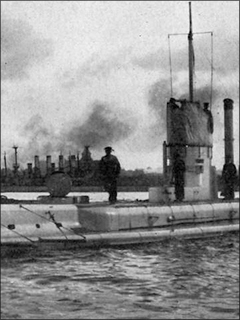 I’ve been interested in submarine warfare 0f the Second World War since I was in middle school. There are a lot of books written in English about the German U-boat campaign targeting Allied ships in the Atlantic and also the American submarine war against Japanese merchant shipping in the Pacific. Relatively little has been written in recent times, though, about submarine operations of any nation during the First World War.
That’s why I was happy to discover a copy of Edwyn Gray’s book, The U-boat War: 1914-1918 (which was originally published in the 1970s as The Killing Time) in Manhattan’s mecca for rare books: the Strand Book Store. I’m really glad I bought this book, because after reading it, I disabused myself of several erroneous notions about these early German submarine operations.
For example, I previously believed that German submarines during WWI in comparison to their counterparts in WWII
- were generally smaller, slower, and carried less fuel, crew, and torpedoes,
- exclusively operated in the coastal waters of Western Europe, and
- did not wage as large or effective of a campaign against merchant shipping.
All of these preconceptions turned out to be false. By way of comparing the U-boat campaigns of the First and Second World War, I turned to some data from uboat.net, an ongoing research project by an amateur historian which I’ve enjoyed visiting since I first started using the internet in the mid-1990s.
Just looking at how many ships U-boats attacked during each war, it’s evident that the number of ships hit by submarines in the 1910s surpasses the totals of the 1940s: (more…)
New songs for old strings
 Jake Runestad is the same age as me (26) and is already making a contribution to society. His new project is described in “Out of War, a Symphony,” an article in the New York Times blog At War. Runestad is composing a three-part piece for orchestra, piano, and chorus hoping to capture the emotional journey that soldiers experience when they go to war and back. He is relying on poetry, memoirs, and interviews with American veterans of the wars in Vietnam, Afghanistan, and Iraq to get a sense of their experiences.
Aside from the social benefit of lifting the veil (if only slightly) for the civilian public about what warfare wreaks on the psyche, Runestad is also helping the cause of classical music. Like other forms of expression which originated many generations ago (including, for that matter, the profession of history) classical music has to confront the stigma of irrelevance. A great way of exhibiting the richness of expression that classical music has to offer is to pair it with the emotional experiences of a new generation. New wine may fare better in new skins, but nothing enlivens the sound of an old instrument like a new song.
New history books (April 2012 edition)

Below is a survey of books that were published in the past month or so and look to me like interesting reads (note: I have not actually read these books yet, and these are previews not reviews).
Russia
 Readers of this blog may notice that my interests have lately been skewed toward the world wars (in particular the air and naval conflicts). When I was a boy my imagination was fired up by stories from my grandfather, who told me about his service as an aviator for the Soviet Navy during the Second World War. I suspect this was when I first became interested in history (I also remember my grandfather reading me a children’s book about the ancient origins of everyday objects, such as matchsticks and clothing irons). Stories about pilots during World War II were my Iliad and Odyssey: they helped me understand concepts such as friendship and courage when I was very young.
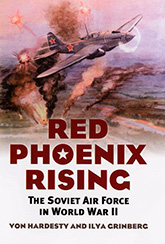
That’s why it’s particularly disappointing that there is hardly anything written in English about the air war on the Eastern Front during World War II. The struggle for dominance in the skies over Eastern Europe between 1941 and 1945 was the largest and longest air campaign in history according to amateur historian Christer Bergström (whose two sets of books about this conflict — Black Cross/Red Star and The Air Battle series — are some of the only comprehensive histories in English on the subject). That’s why I was eagerly awaiting the release in late March of a new book by Von Hardesty and Ilya Grinberg, titled Red Phoenix Rising: The Soviet Air Force in World War II. An overhaul of a previous work, Red Phoenix Rising will hopefully do justice to the drama and significance of this struggle (Bergström’s works, if meticulous, are admittedly dry to read). (more…)
A generation passed away

From left to right: Florence Green (d. 2012; UK), Claude Choules (d. 2011; UK), Frank Buckles (d. 2011; US), and Erich Kästner (d. 2008; Germany)
The last surviving veteran of World War I, Florence Green, died last Saturday. The last American to have served in the war, Frank Buckles, as well as the last veteran to have actually seen combat, Claude Choules, died last year. Their generation saw the accumulation of European culture and technology–the hope of the world–burn for four years on the pyre of war. Theirs was also the first generation to sweep away the ashes and sculpt new strains of Western culture. But almost everything that they (and others after them) wrote, painted, said, and filmed bore the mark of the trauma of World War I.
With the death of these last veterans, we have lost the eyewitnesses to these events. All data now about that time will be secondhand. And collective memory fades quicker when individual memories are stored on hard drives, manuscripts, and film than in human heads.
But there are important lessons to be learned from the experiences this generation recorded. These lessons are best not forgotten, as the men and women would once have told us, who witnessed the radiant procession of humanity in the brilliant summer of 1914 unwittingly march to their oblivion.
What have we learned from the Iraq War?
The news stories are sounding awfully familiar. Nuclear weapons inspectors return home from the Middle East frustrated by their uncooperative hosts. The U.S. threatens military action. Television and radio channels across the world beat the battle drums. Public opinion rises in favor of war.
It seems like the prelude to the Iraq War is now repeating itself with Iran. The bulk of American armies quartered in Iraq flew back home in December. They were met in the United States quietly and with respect for their hard-fought victories. But the nation also remained silent about what the Iraq War has meant for the future of American foreign and domestic policy. There has been no real dialogue about this, and that is worrisome.

Source: NBC News/WSJ Polls via PollingReport.com
America buried thousands of its soldiers in the Middle East, and Iraq lost hundreds of thousands of soldiers and civilians because of the conflict. The Iraq War cost the American taxpayer nearly 2 trillion dollars. This money could have been used to help solve the healthcare problems in America or even just eliminate our chronic budget deficits.
But the public seems willing to sacrifice more blood and treasure in Iran without even discussing the cost. Saddled by a monstrous amount of debt, can our nation even afford another such war?
The president, who may have to take a hard line against Iran as a diplomatic tactic, can’t initiate a national dialogue about the feasibility of war in Iran. That’s the job of Congress, the media, and the public–before the decision is made for us. And the war in Iraq is an excellent reference point for such a debate.
New history books (January 2012 edition)

Below is a survey of books that were published in the past month or so and look to me like interesting reads (note: I have not actually read these books yet, and these are previews not reviews).
…
War of 1812
 This year marks the 200th anniversary of the War of 1812. Many overlook this conflict, but it inaugurated important changes for America. During the war, America tried unsuccessfully to invade Canada, Washington D.C. was invaded and burned by the British, American Indian unification efforts (which were supported by the British) against the colonists were dealt a punishing blow, and the lyrics of the “Star Spangled Banner” were composed. After the war, British and American relations began to improve until eventually the two nations became each other’s closest ally in the 20th Century.
Several new books are being published in commemoration of the anniversary. Three that were released last year—two popular ones by George C. Daughan and Stephen Budiansky and a more scholarly one by Kevin D. McCranie—focus on the naval conflict. But the best new overview of the War of 1812 is by J.C.A. Stagg and is due to come out on March 31 of this year.
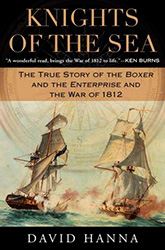
The book I’m most excited to read, though, is David Hanna’s Knights of the Sea: The True Story of the Boxer and the Enterprise and the War of 1812. The ships HMS Boxer and USS Enterprise dueled off the coast of Maine on a brisk autumn day. The captains of the opposing vessels were later buried together in a dual funeral on the American shore, inspiring the poem “My Lost Youth” by Henry Wadsworth Longfellow. (more…)
Memoirs of a Russian submariner
 In high school English class, I was taught about the three general types of conflict that one may encounter in literature: Man vs. Nature, Man vs. Man, and Man vs. Self. Memoirs from combatants of the Second World War are often as exciting to read as literature because all three types of conflict figure into them on a grand scale. But there is a fourth type of conflict that we didn’t learn about in class but which, particularly for the men and women of the Soviet armed forces, added that extra dimension of drama: Man vs. Machine.
The nation that brought the world Lada and Zhiguli cars–which asked of their owners to spend nearly every weekend under their jacked-up chassis salving their ever-irritated metal bowels–produced submarines during WWII that would never quite pass muster in an American or German shipyard. This run-down state of submersible machinery can be fully appreciated by reading Victor Korzh’s memoir, Red Star Under the Baltic: A Soviet Submariner in WWII.
As the chief engineer aboard these subs, Korzh knew every nut and bolt and describes their mechanical failures with the technical detail befitting a master. But the inability of Soviet designers and shipyards to perfect submarine design is no stain on the reputation of the Russian sailor. On the contrary, the Russian submariners’ ability to not only survive but also sink many German merchantmen in the unforgiving seas of the Baltic is a testament to their boldness and technical ingenuity. (more…)
Love of art in the Siege of Leningrad

This first of a series of posts, called “In the Abstract”, are ideas for topics for new history books. Sometimes historians, I think, shoot themselves in the foot by framing their research projects in an uninteresting way. Others, though, do this masterfully and create history books that are engaging, relevant, insightful, and bring the characters and world of another age to life not only for the academic community but for the general public too. Often the path of success or failure begins in the choice of topic. In an effort to sharpen my skills in framing historical topics, I welcome your criticism and comments of my imaginary abstract.
…
ART is frequently seen as flourish to life for those that can afford leisurely activities. Love of art is something that supposedly dies in people when other, more basic, human needs are not being met. But to a select group of Russian writers, poets, artists, and musicians that lived in Leningrad during the siege of 1941-44 by the German army, the drive to produce new creative work did not vanish. Amid the base struggle for survival in that city under blockade, with starvation, violence, death, cannibalism, terror, and inhumanity permeating their existence, many artists in Leningrad later wrote that they experienced the strongest artistic drive of their lives. There has not been a book in English devoted to their stories. A book about the individuals, meeting places, and creative works that these artists produced (among them Dmitri Shostakovich’s Symphony No. 7–the “Leningrad Symphony”) under the most unpromising circumstances would be a testament to the basic importance of creativity in human life.
History off the press (December ’11 edition)

Below is a survey of books that were published in the past month or so and look to me like interesting reads (note: I have not actually read these books, and these are previews not reviews).
…
Africa
 I’m currently reading William L. Shirer’s The Rise and Fall of the Third Reich, and one of among many striking things about Nazi Germany is how easily a multitude of religious leaders in that country kowtowed to Hitler’s religious decrees (which needless to say were staggering in their impiety—replacing the Bible in pulpits with Mein Kampf, for instance). Religions like Christianity derive their power from writing and oratory. But if those mesmerizing words are not backed by deeds when the going gets rough (i.e. when the Gestapo will kill you if you continue practicing authentic Christianity) then such sermonizing appears in hindsight like idle chatter.
That’s why I can’t help but admire a guy like Sam Childers. After he converted to Christianity, he traded a life of drugs, motorcycle gangs, and chasing women in America to become a machine-gun armed protector of orphans and other destitute children in violence-ravaged Sudan. That’s some tough, in-your-face Christianity and not of the “Have you heard the Good Word? Here, take a pamphlet” variety. Childers has published a memoir of his experiences. (more…)
 HistoryJournal.org
2 comments